Grocery retail is often described as one of the most price sensitive sectors in retail. Customers compare prices on everyday essentials, competitors promote aggressively, and retailers closely monitor price perception. In response, pricing teams frequently adjust prices to protect traffic and basket size.
However, not every price change drives additional volume.
In fact, many staple products in grocery categories show lower elasticity than commonly assumed. Small price reductions on certain high frequency items do not always increase demand in a meaningful way. And when pricing systems react to every competitor move without understanding elasticity, margin erosion becomes inevitable.
This is why modern Pricing Software for Retail must do more than execute price updates quickly. It must understand when price changes genuinely influence volume and when holding price is the more profitable decision.
With Pricing AI and competitive relevance filtering, platforms like Hypersonix help grocery retailers distinguish between situations that require action and those where disciplined price holds protect margin.
Before exploring how elasticity changes grocery pricing strategy, it is important to understand why the assumption that lower price always equals higher volume is flawed.
The Myth That Every Price Drop Drives Demand
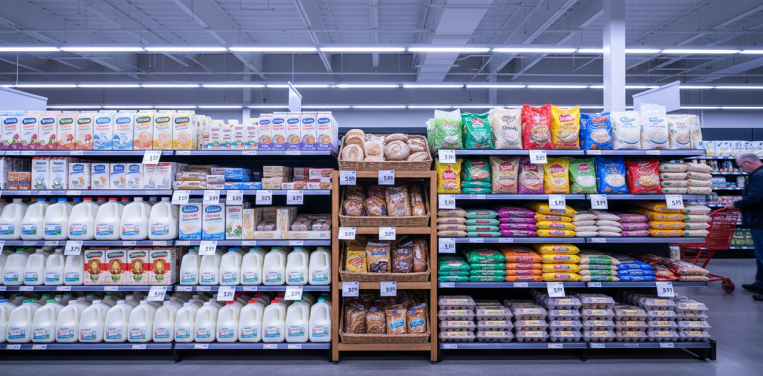
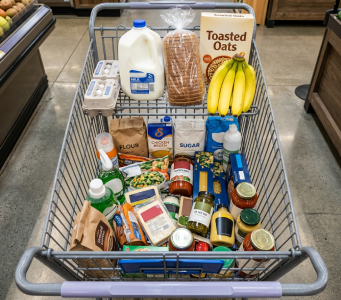
In grocery retail, staples such as milk, bread, rice, eggs, canned goods, and household basics are frequently purchased and highly visible. Because they are so visible, pricing teams often assume they must always remain aligned with competitors.
While some staples are highly price sensitive, others are surprisingly resilient. Customers may purchase them out of habit, convenience, brand preference, or proximity rather than small price differences.
When Pricing Software for Retail applies blanket matching rules, it treats all staples as equally elastic. If a competitor lowers price by a small percentage, the system matches automatically.
But if demand would have remained stable at the original price, the retailer has simply given away margin without increasing volume.
Over time, these small unnecessary adjustments accumulate. Baseline margins reset lower, even though customer behavior never required the change.
Understanding elasticity is what prevents this slow margin drift.
What Low Elasticity Staples Really Mean
Elasticity measures how sensitive demand is to price changes. In grocery, elasticity varies significantly across SKUs.
Low elasticity staples are products where small price changes do not significantly influence purchase volume. These items may have strong brand loyalty, limited substitutes within the store, or habitual purchase patterns.
For example, a customer who shops weekly may continue purchasing the same staple product even if the price is marginally higher than a competitor. Convenience and routine often outweigh small differences.
When Pricing Software for Retail identifies low elasticity SKUs correctly, it gains the confidence to recommend price holds even when competitors adjust prices.
This discipline protects margin without sacrificing demand.
Why Reactive Pricing Creates Margin Leakage in Grocery
Grocery markets are high frequency environments. Competitor price changes are common and often temporary. Local promotions, short term discounts, and limited inventory offers generate constant pricing noise.
Without intelligent filtering, pricing systems treat all competitor activity as equally important.
Reactive systems typically follow a simple logic. Competitor lowers price. Match immediately. Demand slows slightly. Discount further.
This reflexive behavior is particularly dangerous in low elasticity staples.
When price reductions do not materially increase volume, they reduce gross margin directly. Across thousands of high velocity SKUs, even minor unnecessary discounts can have a significant cumulative impact.
Pricing Software for Retail must prevent this pattern by grounding decisions in demand response rather than competitor movement alone.
How Pricing AI Identifies When Price Holds Are Smarter
Pricing AI models elasticity at the SKU level using historical pricing behavior, sales data, and contextual factors. Instead of assuming that a price drop will protect volume, it evaluates how demand has actually responded in similar situations.
If elasticity signals show that demand remains stable despite small price differences, Pricing AI can recommend holding price confidently.
This recommendation is not passive. It is a deliberate, evidence based decision to protect margin.
For higher elasticity staples where demand truly shifts with price changes, Pricing AI can guide targeted adjustments. The difference is precision. Not every product requires the same response.
Modern Pricing Software for Retail must make this distinction automatically and at scale.
Filtering Competitor Noise Before Acting
Elasticity signals are powerful, but they must be paired with accurate competitive interpretation.
Not all competitor moves matter. A temporary local promotion may not influence sustained customer behavior. A low volume competitor may not meaningfully affect demand. A non equivalent product may not be a true substitute.
Competitor AI ensures that only relevant and comparable competitive signals influence pricing decisions. Accurate product matching and relevance filtering prevent unnecessary reactions to noise.
When Pricing Software for Retail combines elasticity modeling with competitive filtering, price holds become rational rather than risky.
The Power of Strategic Price Holds
In grocery, price holds are often misunderstood as inactivity. In reality, they are strategic tools.
Holding price on low elasticity staples achieves several outcomes:
It protects gross margin on high velocity items.
It stabilizes baseline pricing and reduces volatility.
It prevents unnecessary category wide price resets.
It maintains price perception without overcorrecting.
Over time, disciplined price holds compound into meaningful margin protection.
Retailers that rely solely on discounting to maintain competitiveness often struggle to recover profitability. Those that understand when price changes do not drive volume maintain stronger margin foundations.
Micro Adjustments Instead of Blanket Reductions
Low elasticity does not mean prices should never move. It means movements should be evidence driven.
Pricing AI enables micro adjustments rather than sweeping reductions. A small increase on a resilient SKU can generate incremental margin without affecting demand. A targeted adjustment on a genuinely price sensitive staple can protect traffic without triggering widespread discounting.
Across large grocery assortments, these precise adjustments create a more stable and profitable pricing structure.
Pricing Software for Retail must support this level of granularity in high velocity categories.
Building Confidence in Data Driven Restraint
One of the greatest challenges in grocery pricing is organizational pressure. When competitors discount staples, stakeholders expect immediate reaction.
Explainable pricing intelligence addresses this pressure. When elasticity signals clearly show expected demand impact and margin outcomes, teams gain confidence to hold price.
Decisions become evidence based rather than fear driven.
Modern Pricing Software for Retail must provide transparency alongside intelligence so that disciplined pricing becomes sustainable across teams.
Conclusion
In grocery retail, the assumption that every price change drives volume is costly. Many staple products show lower elasticity than expected, meaning that unnecessary price reductions erode margin without delivering incremental demand.
Pricing Software for Retail must move beyond automatic matching and reactive discounting. By combining SKU level elasticity modeling with competitive relevance filtering, retailers can identify when price holds are smarter than price cuts.
Platforms powered by Pricing AI and Competitor AI enable grocery retailers to act with precision rather than reflex. In high frequency markets, the advantage does not belong to the retailer who changes price the most. It belongs to the retailer who understands when price changes do not matter at all.




Ready to Let AI Agents Work for Your Margins?
Leading brands are already growing profits on autopilot. Join them.


Trusted by 1000+ leading retail brands