Competitive pricing has become one of the most common tactics in modern retail. With constant access to competitor prices, retailers feel compelled to match or undercut rivals to stay visible and relevant. On the surface, this approach appears logical. If competitors lower prices, matching them should protect demand.
In reality, competitive pricing without context is quietly destroying profitability. Retailers react to competitor moves without understanding whether those moves matter, whether the products are truly comparable, or whether customers are actually price sensitive in that moment. Over time, these reactive decisions lead to margin erosion, distorted demand signals, and weakened price credibility.
This is not a pricing problem caused by lack of data. It is a context problem. Hypersonix Pricing AI and Competitor AI address this gap by transforming raw competitive signals into informed, profit-driven pricing decisions.
Before exploring how AI restores context, it is important to understand why competitive pricing alone fails so often.
The Illusion of Competitive Pricing
Retailers today have unprecedented access to competitor data. Price scraping tools, marketplaces, and comparison engines provide constant visibility into rival activity. However, visibility does not equal understanding.
Most competitive pricing strategies assume that every competitor price move represents a real threat. When a rival drops price, teams feel pressure to respond immediately. What is often missing is context. Is the competitor running a short-term promotion? Is the product truly equivalent? Is demand actually at risk if price is held?
Without answering these questions, retailers react blindly. Prices move down far more often than they move up, even when demand would hold. Over time, this behavior trains customers to expect discounts and reduces the ability to sell at full value.
Competitive pricing without context turns pricing into a defensive exercise rather than a strategic one.

Where the Real Cost Shows Up
The financial damage caused by context-free competitive pricing rarely appears as a single large loss. Instead, it accumulates quietly across thousands of decisions.
Retailers lose margin by matching discounts that were never necessary. They sacrifice revenue by lowering prices on low elasticity products that customers would have purchased anyway. They also distort performance data by creating artificial demand spikes that misrepresent true customer behavior.
In many cases, pricing teams believe they are protecting volume, when in reality they are funding unnecessary discounts that competitors never intended to sustain.
These losses compound over time. What begins as a small price reaction becomes a long-term margin drain measured in millions.
Why Traditional Competitive Pricing Tools Fall Short
Most competitive pricing tools focus on speed and coverage rather than relevance. They track as many competitor prices as possible and trigger alerts whenever changes occur. This flood of information creates noise instead of clarity.
Traditional systems struggle in three critical areas. First, they fail at accurate product matching. Similar looking products are often treated as equivalents even when specifications, bundles, or quality differ. Second, they lack elasticity awareness. Every price move appears urgent even when demand is not sensitive. Third, they provide no prioritization. Temporary promotions and structural price changes are treated the same.
As a result, pricing teams spend their time reacting instead of analyzing. Decisions are driven by fear of losing share rather than understanding actual customer behavior.
This is where Hypersonix changes the equation.
How Hypersonix Competitor AI Adds Context to Competition
Hypersonix Competitor AI does not simply collect competitor prices. It evaluates relevance.
The system uses AI-powered product matching to ensure that comparisons are made between true equivalents or meaningful substitutes. This prevents false signals caused by mismatched SKUs or incomplete product attributes.
Competitor AI also evaluates the nature of competitor moves. It distinguishes between temporary discounts, promotional noise, and meaningful price resets. Instead of treating every change as urgent, it surfaces only the competitive activity that has the potential to influence demand or price perception.
This filtering alone removes a significant portion of unnecessary pricing reactions and gives teams room to think strategically.

How Pricing AI Determines Whether a Response Is Actually Needed
Context does not stop with competitors. Customer behavior matters just as much.
Hypersonix Pricing AI brings elasticity into every pricing decision. It measures how sensitive demand is to price changes at the SKU and category level. This allows retailers to understand when a competitor move poses real risk and when holding price is the more profitable choice.
If a competitor discounts a low elasticity product, Pricing AI may recommend maintaining price and protecting margin. If the product is highly elastic and demand is at risk, it recommends a calibrated adjustment rather than a blanket match.
This approach replaces instinct-driven reactions with evidence-based decisions that balance competitiveness and profitability.
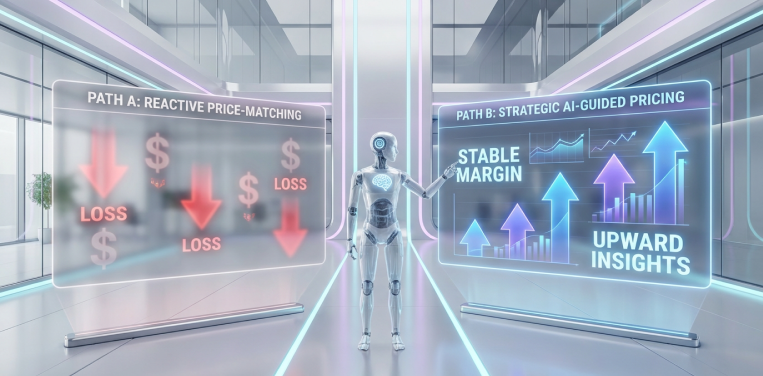
From Reactive Matching to Strategic Pricing
When Pricing AI and Competitor AI work together, competitive pricing becomes strategic instead of reactive.
Retailers gain the ability to see which competitor actions matter, understand how customers will respond, and choose the right pricing response based on both market and behavioral context. Prices move with purpose, not panic.
This shift also improves internal alignment. Pricing, merchandising, and finance teams operate from a shared understanding of why prices change or stay the same. Decisions are no longer debated emotionally but evaluated through consistent logic.
Over time, this discipline strengthens price credibility, protects margin, and restores confidence in pricing strategy.
The Long-Term Impact of Contextual Competitive Pricing
Retailers who price with context experience measurable benefits. They discount less frequently while remaining competitive. They recover margin without sacrificing demand. They generate cleaner data that improves future pricing decisions. Most importantly, they stop funding unnecessary price wars that competitors never intended to sustain.
Competitive pricing does not disappear. It evolves. Instead of copying competitor moves, retailers use intelligence to decide when competition truly matters.
Conclusion
Competitive pricing without context is one of the most expensive habits in modern retail. It feels safe in the moment but quietly erodes profitability over time.
Hypersonix Pricing AI and Competitor AI give retailers the missing context needed to price intelligently. By combining accurate competitor relevance with elasticity-driven insight, retailers can protect margin, maintain competitiveness, and make pricing decisions that reflect real customer behavior.






Ready to Let AI Agents Work for Your Margins?
Leading brands are already growing profits on autopilot. Join them.


Trusted by 1000+ leading retail brands