Grocery pricing teams do not have the luxury of slow decision cycles. High-velocity categories move quickly. Competitor promotions change weekly. Staples shape price perception. Private labels protect margin and differentiation. Perishables carry freshness, shrink, and availability risk. A small pricing decision on the wrong product can create margin leakage, inventory pressure, or customer trust issues across the basket.
The challenge is not that grocery teams lack signals. It is that they have too many of them.
A competitor lowers the price on milk. A private label cereal gap widens against a national brand. Produce inventory builds faster than expected. A weekly ad changes the effective price in a competing store. A key value item is suddenly out of line. A margin floor is approaching on a high-volume SKU. Across thousands of grocery products, these signals can create hundreds of pricing exceptions.
Not every exception deserves the same level of attention.
Modern grocery pricing requires a way to prioritize where action matters most. Hypersonix helps retailers bring together competitor context, expected demand impact, inventory and forecasting signals, margin guardrails, and product-role rules so pricing teams can focus on the exceptions that carry the greatest business impact.
The goal is not to review every SKU manually. It is to know which products require a move, which require a hold, which need review, and which should be investigated before any pricing action is taken.
Why Grocery Pricing Exceptions Are Harder Than They Look
Grocery pricing is complex because products play very different roles in the basket.
A small gap on a staple can influence shopper price perception. A private label product may require careful positioning against a national brand. A perishable item may need attention because the cost of waiting is higher than the cost of action. A long-tail packaged item may not deserve urgent review, even if a competitor appears cheaper.
The same price gap can mean different things depending on the product.
For example, a 5 percent competitor gap on a highly visible staple may deserve immediate review. The same gap on a low-velocity specialty item may have little effect on customer behavior. A discount on strawberries may be urgent if inventory is high and freshness risk is rising. A discount on a shelf-stable item may be less urgent if demand is stable and margin is strong.
This is why exception prioritization must reflect product role, business exposure, and operating context.
The Problem With Treating Every Alert Equally
Many pricing workflows still begin with a long list of alerts.
- A competitor is cheaper.
- Inventory is above target.
- Demand is softer than expected.
- Margin is below plan.
- A promotion is approaching.
- A price recommendation exceeds a threshold.
Each alert may be true, but that does not mean each one deserves immediate action.
When alerts are treated equally, teams spend valuable time on low-impact items while more important exceptions wait. Analysts may review a small competitor gap on a slow-moving SKU while missing a margin risk on a staple that appears in thousands of baskets. Merchandising may debate a minor price move while a perishable category nears its selling window.
A better model ranks exceptions by business impact.
This means asking:
- Which products influence price perception?
- Which SKUs carry the largest revenue or margin exposure?
- Where is inventory risk rising?
- Where is demand most likely to respond to price?
- Which competitor signals are reliable and relevant?
- Which recommendations approach margin or movement guardrails?
Hypersonix supports this more focused model by helping teams prioritize exceptions instead of manually sorting through every possible issue.
Staples Need Price-Image Discipline
Staples are often the products shoppers remember.
Milk, eggs, bread, rice, flour, butter, bananas, pasta, and other frequently purchased items can shape a customer’s perception of whether a grocer feels competitive. These products may not always be the highest-margin items, but they influence trust and basket behavior.
That does not mean every staple should be matched to the lowest visible competitor price.
Staple pricing still requires clean context. A competitor offer may involve a different pack size, loyalty condition, regional promotion, or temporary ad price. A marketplace or delivery listing may not reflect the same shopping occasion. A competitor price may be visible but not relevant to the shopper’s actual store choice.
Hypersonix Competitor AI helps improve product matching and relevance filtering so grocery teams can compare true-equivalent offers. Competitor monitoring can be configured on daily, weekly, or monthly cycles depending on category volatility and business needs.
For staples, pricing exceptions should move up the queue when the product is highly visible, the competitor match is reliable, the competitor is relevant, and the gap is large enough to influence price perception or demand.
Private Labels Need Positioning, Not Just Price Cuts
Private label pricing is not only about being cheaper.
Private labels often serve several goals at once: margin protection, differentiation, value perception, and category architecture. A private label item may need to maintain a clear relationship to the national brand, but the right gap depends on the category, product quality, customer trust, and retailer strategy.
If pricing teams treat private label exceptions as simple competitor gaps, they can damage the category logic.
For example, if the private label price moves too close to the national brand, the value proposition may weaken. If it moves too low, the retailer may give away margin unnecessarily. If competitor private label comparisons are not truly equivalent, the retailer may react to the wrong benchmark.
Private label exceptions should be prioritized based on:
- the product’s role in the category
- the intended gap to national brands
- margin contribution
- customer price sensitivity
- competitor relevance
- pack-size equivalence
- recent price movement
- guardrail risk
Hypersonix Pricing AI supports targeted recommendations using historical sales and pricing patterns. This helps teams evaluate whether a move is likely to influence demand or whether holding the private label price protects more value.
The goal is to protect the value architecture, not simply lower the price.
Perishables Require Faster Context Because Time Matters
Perishables are different because the cost of waiting can rise quickly.
Produce, meat, seafood, bakery, deli, and prepared foods carry freshness and shrink risk. If demand softens or inventory builds, a delayed pricing decision can lead to waste, markdown pressure, or missed sales opportunities.
But even in perishables, high inventory does not automatically mean the base price should be reduced.
The right decision depends on the product’s remaining selling window, demand outlook, incoming supply, promotional plans, margin exposure, and freshness risk. Sometimes a targeted promotion is better than a permanent price change. Sometimes a hold is appropriate because demand is expected to recover. Sometimes the issue is forecasting or replenishment, not price.
Perishable exceptions deserve priority when:
- inventory is rising faster than expected
- the selling window is narrowing
- demand is weakening
- shrink risk is increasing
- a planned promotion may not be sufficient
- the current price is limiting sell-through
- margin guardrails still allow a controlled action
Hypersonix helps connect pricing, inventory, and forecasting context so teams can separate urgent perishable risks from routine fluctuations.
Competitor Signals Must Be Validated Before They Drive Action
Grocery competitive pricing is full of misleading comparisons.
Pack sizes, multipacks, loyalty offers, coupons, delivery fees, regional availability, temporary ads, and bonus packs can all distort the benchmark. A competitor may appear cheaper, but the real offer may not be equivalent.
If teams react before validating the signal, they can create unnecessary price cuts.
This is especially risky in high-velocity categories because small changes can have large financial consequences. A wrong move on a high-volume grocery SKU can affect thousands of units quickly.
Hypersonix Competitor AI helps improve match quality and filter irrelevant signals so teams focus on comparisons that matter. Before a competitor exception moves to the top of the queue, teams should understand:
- Is the product truly equivalent?
- Is the pack size comparable?
- Is the offer temporary or structural?
- Is the competitor relevant for this category or market?
- Is the gap meaningful enough to influence demand or price perception?
A validated competitive exception deserves more attention than an unverified undercut.
Expected Demand Impact Helps Rank Exceptions
A price change should not be prioritized only because the gap looks large.
The important question is whether the action is likely to produce a meaningful business result.
Some grocery products are highly price-sensitive. A small move can influence demand, basket inclusion, or shopper perception. Other products may be less responsive because customers buy them out of habit, brand preference, convenience, or need.
Hypersonix Pricing AI uses historical sales and pricing patterns to support expected demand impact at the SKU or product-cluster level. This helps grocery teams understand where a price move may pay back and where a discount may simply give away margin.
An exception should move higher in priority when:
- the product has meaningful revenue or margin exposure
- expected demand impact is material
- the competitor signal is reliable
- inventory or freshness risk adds urgency
- the move fits within guardrails
- the product role supports action
If the expected demand impact is weak, a price hold may be the better decision.
Guardrails Keep Fast-Moving Categories From Drifting
High-velocity categories can create frequent pricing decisions. Without guardrails, frequent decisions can become gradual margin erosion.
A few small price cuts may appear harmless at first. But if they repeat across weekly cycles, they can reset the base price and weaken profitability.
Hypersonix supports guardrails such as:
- margin floors
- movement limits
- meaningful gap thresholds
- price holds
- category-specific rules
- product-role constraints
- exception-based review
These controls are especially important in grocery because high-volume products can magnify the impact of small pricing changes.
A margin floor can prevent a recommendation from crossing an unacceptable profitability level. A movement limit can reduce repeated small cuts on the same SKU. A meaningful gap threshold can stop teams from reacting to competitor differences that are too small to matter.
Guardrails help grocery teams act quickly without losing control.
Product Role Should Define the Priority
Grocery categories include different product roles, and each role should influence exception priority.
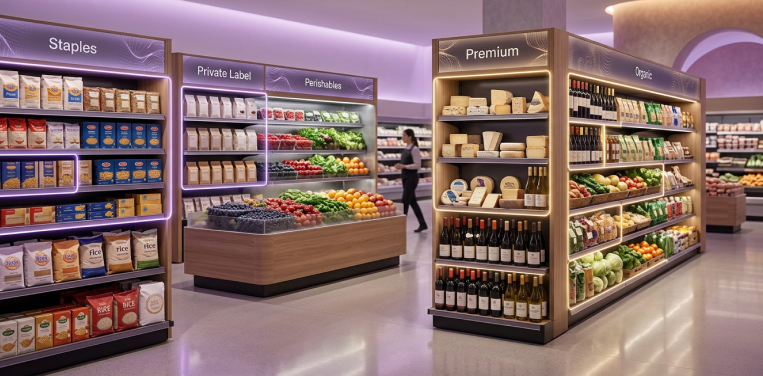
Staples and key value items may deserve tighter competitive monitoring because they influence price image. Private labels may require value-architecture discipline. Perishables may need faster review due to freshness risk. Premium or specialty products may support wider gaps and stronger hold discipline. Long-tail items may not require frequent intervention unless inventory or margin risk is rising.
A uniform pricing rule across all grocery SKUs creates problems.
It may over-discount differentiated items, underreact to visible staples, or miss perishable risk until it becomes a markdown problem.
A better approach ranks exceptions by product role and business consequence.
For example:
- Staples move up when competitor gaps are validated and meaningful.
- Private labels move up when price architecture or margin contribution is at risk.
- Perishables move up when inventory, freshness, and demand signals indicate urgency.
- Premium items move up when margin or positioning is at risk, not simply because a competitor is cheaper.
- Long-tail items move up only when business exposure justifies review.
This makes pricing more focused and more defensible.
Move, Hold, Review, or Investigate
Prioritization is most useful when it leads to a clear next step.
A grocery exception should not simply remain on a dashboard. It should be routed into a decision path.
Move
A move may be appropriate when the competitor match is reliable, the product is relevant to price perception or demand, expected impact is meaningful, and the recommendation fits within margin and movement guardrails.
Hold
A hold may be appropriate when the competitor signal is weak, the offer is temporary, the gap is too small, demand is resilient, or the margin trade-off does not pay back.
Review
A review may be needed when the exception has potential business impact but requires validation. This could include uncertain product matching, unclear competitor relevance, inventory pressure, or a recommendation near a margin floor.
Investigate
An investigation may be needed when the issue appears to be data quality, execution inconsistency, product matching, forecasting, or replenishment rather than pricing strategy.
This structure helps grocery teams avoid both overreaction and inaction.
Building a Daily, Weekly, and Monthly Rhythm
High-velocity grocery pricing needs a repeatable rhythm.
Daily reviews can focus on urgent exceptions such as high-impact staple gaps, perishable inventory risk, margin breaches, failed execution, and time-sensitive promotions.
Weekly reviews can evaluate category trends, competitor relevance, private label price architecture, recommendation outcomes, and signs of base price drift.
Monthly reviews can refine guardrails, product roles, competitor sets, thresholds, and operating rules based on performance.
Competitor monitoring can be configured on daily, weekly, or monthly cycles based on business needs. The goal is not constant chasing. The goal is disciplined attention at the right frequency.
How Hypersonix Helps Grocery Teams Prioritize Exceptions
Hypersonix helps grocery retailers move from broad alert lists to focused pricing decisioning.
Competitor AI improves product matching and relevance filtering so teams can compare true-equivalent offers across packs, multipacks, variants, promotions, and seller conditions. Pricing AI uses historical sales and pricing patterns to support expected demand impact and targeted recommendations. Inventory and forecasting context help teams understand when perishables, seasonal items, or high-stock products require attention.
Business guardrails help control decisions through margin floors, movement limits, meaningful gap thresholds, price holds, and product-role rules. Exception-driven workflows help teams prioritize which SKUs require action, review, hold, or investigation.
Together, these capabilities help grocery teams:
- identify which staples need competitive attention
- protect private label value architecture
- prioritize perishables based on demand, inventory, and freshness risk
- avoid false undercuts from pack-size or promo noise
- hold price when a move is not justified
- protect margin through controlled guardrails
- reduce manual review across large assortments
- focus decision time on the SKUs with the greatest business impact
The goal is not to create more pricing activity. It is to make grocery pricing decisions more precise, explainable, and profitable.
Conclusion
Grocery pricing exceptions are not equal.
A competitor gap on a visible staple, a private label price architecture issue, and inventory pressure on a perishable item all require different levels of urgency and different decision logic. Treating every alert the same leads to wasted time, unnecessary discounting, and missed opportunities.
Hypersonix helps grocery retailers prioritize pricing exceptions by connecting clean competitor intelligence, expected demand impact, inventory and forecasting context, product-role rules, and business guardrails.
That allows teams to decide what deserves action first, what should hold, what needs review, and what requires investigation.
In high-velocity grocery categories, the advantage does not come from reacting to everything. It comes from knowing which decisions matter most.

Related Resources:


Ready to Let AI Agents Work for Your Margins?
Leading brands are already growing profits on autopilot. Join them.


Trusted by 1000+ leading retail brands