Furniture pricing is rarely as simple as comparing one product price to another. A sofa may appear cheaper on a competitor’s site. A dining table may be listed at a lower price. A bed frame may show a more aggressive promotion. At first glance, the pricing team may feel pressure to respond quickly, especially when the product is visible, high-ticket, and conversion-sensitive.
But in furniture retail, the product price is only one part of the offer.
Delivery fees, assembly services, room-of-choice placement, haul-away options, return windows, warranty coverage, financing terms, lead times, product condition, customization, and seller reliability can all change the true value of the purchase. A competitor may look cheaper on the item page but become less attractive once shipping, handling, assembly, or service terms are included.
If pricing teams react only to the headline product price, they risk cutting prices unnecessarily. The retailer may already be competitive on the full offer, but the comparison is being distorted by incomplete context.
This is why furniture retailers need to compare the full offer before adjusting price.
Hypersonix helps retailers bring more discipline to furniture pricing by connecting competitor intelligence, product matching, relevance filtering, expected demand impact, inventory and forecasting context, business guardrails, and exception-driven workflows. Competitor AI helps validate whether the competitor product and offer are truly comparable. Pricing AI uses historical sales and pricing patterns to support targeted recommendations, disciplined holds, and expected demand impact. Guardrails such as margin floors, movement limits, meaningful gap thresholds, and price holds help teams protect margin when a visible price gap does not reflect the total customer value.
The goal is not to ignore competitor prices. It is to understand whether the retailer is truly undercut once the full offer is considered.
Why Furniture Price Comparisons Are Often Incomplete
Furniture purchases include more decision factors than many other retail categories.
A customer buying a sectional, mattress, dining set, dresser, office desk, or outdoor furniture set is not only asking, “What is the item price?” They are also asking whether the product will arrive on time, who will bring it inside, whether assembly is included, what happens if it does not fit, whether the quality is comparable, and whether the retailer will stand behind the purchase.
Two furniture offers can have the same product price but very different customer value.
One retailer may include threshold delivery. Another may charge separately for freight. One may offer room-of-choice placement. Another may deliver only to the curb. One may include assembly. Another may require customers to build the item themselves. One may show a lower price but have a longer lead time, limited return flexibility, or unclear seller terms.
When these differences are ignored, pricing teams may treat a competitor’s lower item price as a true undercut even when the overall offer is not equivalent.
That creates unnecessary margin pressure.
Headline Price Can Hide the Real Cost to the Customer
The headline product price is often the most visible part of the comparison, but it may not represent the full cost.
A competitor might advertise a dining table at $799 while the retailer lists a similar table at $849. At first, the competitor appears $50 cheaper. But if the competitor charges $149 for delivery while the retailer includes delivery or offers better service terms, the full customer value may be very different.
The same issue applies to assembly.
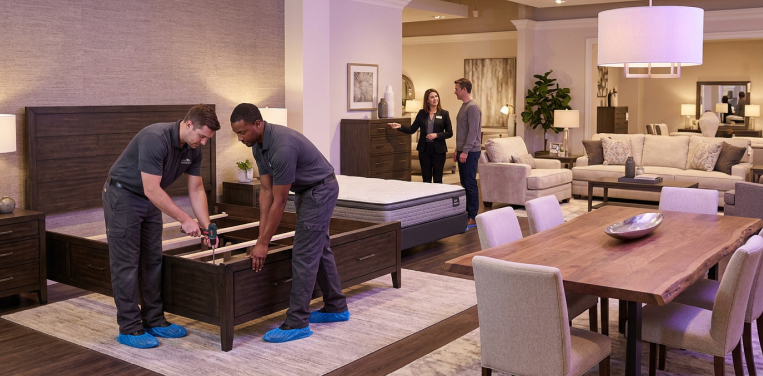
A bed frame with included assembly may justify a higher product price than a lower-priced competitor offer that arrives flat-packed with no service support. A sofa with room-of-choice delivery may be more valuable than a curbside-only option. A white-glove delivery offer may reduce customer friction and protect satisfaction, especially on large or heavy items.
Pricing teams need to normalize these offer components before deciding whether a price response is justified.
The right question is not only, “Who has the lower product price?”
It is, “Who has the stronger total offer?”
Delivery Terms Can Change the Benchmark
Delivery is one of the most important variables in furniture pricing.
Large, heavy, fragile, or high-ticket items often carry meaningful logistics costs. The way those costs are presented can distort competitor comparisons. Some retailers show a lower product price and recover cost through delivery fees. Others include delivery in the product price or offer free shipping above a threshold. Some offer curbside delivery, while others include room-of-choice placement.
These differences matter because they affect both customer decision-making and retailer margin.
Delivery terms to compare may include:
- shipping cost
- free shipping threshold
- curbside delivery
- threshold delivery
- room-of-choice delivery
- white-glove delivery
- lead time
- scheduled delivery availability
- regional availability
- damage handling
- return pickup terms
If a competitor’s lower price excludes services the retailer includes, a price cut may not be necessary. The correct response may be a hold, a merchandising explanation, a delivery-value comparison, or a review of whether the retailer’s full offer is being communicated clearly.
Hypersonix Competitor AI helps teams evaluate offer-level details so pricing decisions are not based only on surface-level product prices.
Assembly Is Part of the Value Equation
Assembly can meaningfully change the customer’s perceived value.
Furniture products often require time, effort, tools, or expertise to assemble correctly. A lower-priced competitor offer may shift that burden to the customer. Another offer may include assembly or provide service options that reduce friction.
A price gap should be interpreted differently when assembly terms differ.
For example, a competitor may sell a bookcase for less but require self-assembly. A retailer offering delivery and assembly may be delivering a more complete service. Similarly, a dining set with included setup may carry a higher value than a flat-pack alternative that requires significant effort.
This distinction is especially important for high-consideration categories such as bedroom sets, dining sets, home office, outdoor furniture, and large storage pieces.
If assembly is included or available at favorable terms, pricing teams should evaluate whether the item price needs to move at all. A hold may be more appropriate when the full offer remains competitive.
Product Matching Still Comes First
Before delivery and assembly are evaluated, the product itself must be matched correctly.
Furniture products can look similar but differ in materials, dimensions, finish, construction, upholstery, cushion quality, frame type, configuration, color, warranty, and customization options. A competitor’s lower price may reflect a smaller item, different fabric, lower-quality material, simpler construction, fewer pieces, or a different configuration.
A sectional is not equivalent simply because it has the same general shape. A dining table is not equivalent if the dimensions, materials, or finish differ. A mattress is not equivalent if firmness, construction, size, or warranty terms are different.
Furniture matching should consider:
- dimensions
- material and construction
- upholstery or finish
- configuration
- number of pieces
- size variant
- color or fabric option
- customization availability
- warranty terms
- product condition
- seller or brand credibility
Hypersonix Competitor AI helps improve product matching and relevance filtering so teams can distinguish true-equivalent furniture offers from surface-level lookalikes. This reduces the risk of reacting to false undercuts.
Seller and Marketplace Terms Matter
Furniture marketplaces add another layer of complexity.
A lower price may come from a third-party seller with different service levels, return terms, warranty coverage, delivery reliability, or product condition. The offer may involve longer lead times, limited stock, unclear handling of damaged goods, or different customer support expectations.
For large purchases, seller trust can influence the buying decision.
A customer may be willing to pay more for a trusted retailer that provides clearer delivery, stronger service, easier returns, and better issue resolution. Pricing teams should not automatically use every marketplace listing as a benchmark.
Seller relevance should be part of the pricing workflow.
A competitor offer may be less relevant if it includes:
- unclear seller identity
- limited warranty support
- longer fulfillment times
- restrictive return terms
- unclear delivery service level
- additional handling fees
- limited regional availability
- open-box or outlet condition
- poor service transparency
Hypersonix Competitor AI supports relevance filtering so teams can focus on competitive offers that matter for the category, channel, and customer expectation.
Promotions Can Distort Furniture Price Signals
Furniture retailers often compete through seasonal sales, financing events, free delivery promotions, bundle savings, holiday discounts, and clearance pricing.
These offers can create temporary pressure, but they do not always represent a lasting market shift.
A competitor may reduce price to clear discontinued inventory. A delivery promotion may apply only for a weekend. A bundle price may depend on buying multiple pieces. A financing offer may influence affordability without changing the product’s actual price. A clearance item may not be comparable to a current-season or core assortment product.
If teams treat every promotion as a new everyday benchmark, they may weaken margin and create base price drift.
Hypersonix helps teams evaluate whether competitor activity is temporary, equivalent, and meaningful. Guardrails such as meaningful gap thresholds, movement limits, margin floors, and price holds help prevent temporary promotions from triggering unnecessary permanent price reductions.
Expected Demand Impact Should Guide the Decision
Even when a competitor offer is valid, a price cut may not be the best response.
Furniture purchases are influenced by more than price. Customers may care about size, style, availability, delivery reliability, financing, reviews, return policy, warranty, room fit, and retailer trust. A lower price may increase demand for some products, but it may have limited effect on others if the full offer remains strong.
Hypersonix Pricing AI uses historical sales and pricing patterns to support expected demand impact at the SKU or product-cluster level. This helps teams evaluate whether a price move is likely to generate enough incremental demand to justify the margin trade-off.
A pricing exception should be prioritized when:
- the product match is reliable
- delivery and assembly terms are comparable
- the seller is relevant
- the competitor gap is meaningful after offer normalization
- expected demand impact supports action
- inventory or lifecycle context adds urgency
- the recommendation fits within guardrails
If those conditions are not met, a price hold may protect more value than a reduction.

Inventory and Forecasting Context Matters in Big-Ticket Retail
Furniture has longer purchase cycles and different inventory dynamics than many fast-moving categories.
A product may have long lead times, limited replenishment flexibility, regional stock differences, seasonal demand, or high carrying costs. Inventory pressure may justify action in some cases, but a competitor price gap alone should not drive the decision.
If inventory is healthy and demand is stable, a hold may be appropriate. If stock is building and demand is soft, a targeted promotion or price review may be justified. If the product is being discontinued, clearance logic may apply. If lead times are long or supply is constrained, a price cut may not create meaningful benefit and may simply reduce margin.
Hypersonix helps connect pricing, inventory, and forecasting context so teams can assess whether pressure is competitive, operational, seasonal, or lifecycle-related.
This prevents pricing teams from using price cuts to solve the wrong problem.
Guardrails Protect Margin When Offer Comparisons Are Complex
Furniture pricing needs strong guardrails because many competitor comparisons are incomplete.
Useful guardrails include:
- margin floors to protect profitability
- movement limits to prevent repeated small reductions
- meaningful gap thresholds based on full-offer comparison
- price holds when delivery, assembly, seller terms, or product details are not equivalent
- category-specific rules for premium, core, clearance, or custom products
- exception-based review for uncertain matches
Hypersonix supports these controls as part of a broader pricing workflow. This helps teams avoid unnecessary price changes while still acting when the competitive signal is valid.
A margin floor can stop a recommendation from eroding profitability. A movement limit can flag products that have changed too often. A meaningful gap threshold can prevent action when the true full-offer gap is too small. A price hold can protect margin when the competitor’s lower product price is offset by weaker delivery, assembly, or service terms.
Price Holds Need to Explain the Full Offer
Holding price can be the right decision when the retailer’s full offer is stronger.
But a hold needs to be explainable.
Pricing, merchandising, ecommerce, and finance teams need to understand why a lower visible competitor price does not require a response. The explanation should show the details that change the comparison.
An explainable hold may show:
- the competitor excludes delivery
- the competitor provides curbside delivery only
- assembly is not included
- lead time is longer
- return terms are weaker
- the product dimensions or materials are not equivalent
- the seller is not a relevant benchmark
- the offer is temporary or clearance-driven
- the gap is below a meaningful threshold after full-offer comparison
- expected demand impact is limited
- the move would breach margin or movement guardrails
Hypersonix supports explainable recommendations and exception-driven workflows so teams can defend price holds with evidence instead of relying on judgment alone.
Move, Hold, Review, or Investigate
A furniture pricing exception should lead to a clear decision path.
Move
A move may be appropriate when the product is truly comparable, delivery and assembly terms are equivalent, the seller is relevant, the price gap is meaningful, expected demand impact supports action, and the recommendation fits within guardrails.
Hold
A hold may be appropriate when the competitor’s lower product price is offset by weaker delivery, no assembly, longer lead time, less relevant seller terms, or limited expected demand impact.
Review
A review may be needed when the product appears similar but offer details, delivery terms, assembly services, product materials, dimensions, or seller relevance require validation.
Investigate
An investigation may be needed when the issue appears to involve incorrect product matching, incomplete competitor data, execution inconsistency, inventory pressure, or unclear promotion terms rather than a true pricing problem.
This structure helps teams avoid automatic reactions and apply the right decision logic.
Monitoring Competitors Without Chasing Headline Prices
Furniture retailers need competitive visibility, but they do not need to chase every lower product price.
Competitor monitoring can be configured on daily, weekly, or monthly cycles based on business needs, product volatility, and category strategy. Highly promotional categories may need closer review during key selling periods, while premium, custom, or slower-moving products may require a different cadence.
The purpose of monitoring is to identify meaningful exceptions, not to trigger constant reactions.
Daily reviews may focus on urgent high-impact products, major competitor campaigns, inventory risk, or margin exceptions. Weekly reviews can evaluate category position, repeated holds, competitor relevance, and recommendation outcomes. Monthly reviews can refine competitor sets, offer-normalization rules, guardrails, and product-role assumptions.
A structured rhythm helps furniture teams stay informed without letting every incomplete comparison reset pricing strategy.
Price Execution Monitoring Helps Protect the Approved Decision
Even when a pricing decision is correct, execution can still create margin leakage.
A price may be approved but not applied. A temporary promotion may remain active too long. A price may reach ecommerce but not stores. A delivery promotion may not align with the approved pricing action. A product variant may receive the wrong price.
In furniture, execution gaps can be especially costly because items are high-ticket and offer terms are complex.
Hypersonix price execution monitoring helps verify that approved pricing actions were implemented as intended. This supports follow-through when teams approve a move, maintain a hold, or run a temporary promotion.
Execution monitoring helps ensure that the final market price and offer reflect the decision made in the pricing workflow.
How Hypersonix Helps Furniture Retailers Compare the Full Offer
Hypersonix helps furniture retailers move from headline price comparisons to more complete pricing decisions.
Competitor AI improves product matching and relevance filtering across product attributes, dimensions, materials, configurations, delivery terms, assembly options, seller conditions, promotions, and offer details. Pricing AI uses historical sales and pricing patterns to support expected demand impact and targeted recommendations. Inventory and forecasting context helps teams evaluate stock exposure, lifecycle pressure, and demand outlook.
Business guardrails help teams apply margin floors, movement limits, meaningful gap thresholds, price holds, category-specific rules, and exception-based review. Explainable workflows help teams decide whether a product should move, hold, review, or investigate. Price execution monitoring helps verify that approved pricing actions were implemented correctly.
Together, these capabilities help furniture retailers:
- compare the full offer before adjusting price
- avoid reacting to lower headline prices that exclude delivery or assembly
- validate product equivalence across size, material, finish, and configuration
- filter irrelevant seller or marketplace signals
- protect margin when the retailer’s service offer is stronger
- make price holds visible and defensible
- route uncertain comparisons for review
- reduce manual review across complex furniture assortments
- verify approved price actions after execution
The result is a more controlled pricing process that protects margin while still supporting competitiveness.
Conclusion
Furniture retailers should not adjust price based on headline product comparisons alone.
A lower competitor price may exclude delivery, assembly, room placement, warranty, return support, or reliable seller terms. It may also reflect a different material, dimension, configuration, condition, or clearance status. If retailers react before comparing the full offer, they can cut prices unnecessarily and lose margin without improving customer value.
Hypersonix helps furniture retailers protect margin by combining cleaner competitor intelligence, product matching, full-offer relevance, expected demand impact, inventory and forecasting context, business guardrails, explainable workflows, and price execution monitoring.
The strongest furniture pricing teams do not ask only, “Is the competitor cheaper?”
They ask, “Is the full offer truly comparable, and does the gap justify a price change?”
That is how retailers stay competitive without letting incomplete comparisons erode profitability.





Ready to Let AI Agents Work for Your Margins?
Leading brands are already growing profits on autopilot. Join them.


Trusted by 1000+ leading retail brands