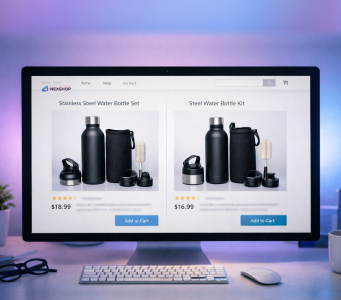
For many eCommerce retailers, pricing strategy has become synonymous with parity. When competitors move, prices follow. When marketplaces discount, matching feels inevitable. Over time, this behavior has shaped how pricing software for eCommerce is designed. Speed of reaction is often treated as the ultimate advantage.
But parity is not profitability.
Matching competitors may protect short term visibility, but it rarely protects margin. In fact, pricing software for eCommerce that focuses only on reacting to competitor prices often accelerates margin erosion, trains customers to expect discounts, and removes strategic control from pricing teams.
Modern eCommerce pricing requires a shift in mindset. The goal is no longer to match the market. The goal is to optimize pricing decisions based on demand behavior, competitive relevance, and financial impact. This is where Pricing AI and Competitor AI change the role of pricing software for eCommerce from a reactive tool into a profit optimization engine.
Before exploring how optimization replaces parity, it is important to understand why price matching became the default and why it no longer works.
The Limits of Price Matching as a Pricing Strategy
Price matching feels safe because it is simple. If competitors drop prices, matching seems like the fastest way to avoid losing demand. Traditional pricing software for eCommerce reinforces this behavior through rules that trigger automatic responses whenever a competitor changes price.
The problem is that price matching assumes all competitive moves are equally important and all customers are equally price sensitive. In reality, neither assumption is true.
Competitors discount for many reasons that have nothing to do with long term demand. Inventory clearance, short term ranking tactics, campaign experiments, or marketplace dynamics often drive temporary price drops. Matching these moves rarely improves performance, but it almost always reduces margin.
When pricing software for eCommerce treats parity as success, pricing decisions become mechanical. Prices move because competitors moved, not because data shows that demand requires it. Over time, this creates a race to the bottom that no amount of automation can fix.
Parity vs Optimization in Modern eCommerce Pricing
Parity focuses on staying equal to competitors. Optimization focuses on achieving the best possible outcome.
In a parity driven model, the primary question is whether a competitor changed price. In an optimization driven model, the question becomes whether that change actually matters and what response maximizes profit.
This distinction is critical.
Optimization requires understanding customer behavior, product elasticity, and competitive relevance. It requires pricing software for eCommerce to evaluate context, not just activity. Without this intelligence, pricing systems cannot distinguish between situations that require action and those where holding price is the most profitable move.
Pricing AI enables this shift by grounding decisions in demand response rather than fear of losing parity.
How Pricing AI Enables Price Optimization
Pricing AI moves pricing decisions beyond rules and averages by modeling how customers actually respond to price changes. Instead of assuming that lowering price will increase demand, Pricing AI evaluates whether demand is sensitive to price at the SKU and product cluster level.
Some products respond strongly to small price changes. Others do not. Some items maintain demand even when priced above competitors because customers value brand, availability, or convenience more than price. Traditional pricing software for eCommerce cannot identify these differences at scale.
Hypersonix Pricing AI continuously analyzes historical pricing behavior, sales response, and contextual signals to determine elasticity for each product. This allows pricing teams to optimize prices rather than defaulting to matching.
Optimization often means holding price when competitors discount. In other cases, it may mean making small, precise adjustments that improve margin without harming conversion. The key is that every decision is tied to expected customer behavior, not competitor pressure alone.

Why Competitor Context Matters More Than Competitor Parity
Optimization is not possible without understanding which competitors actually matter.
Most pricing software for eCommerce relies on basic competitor tracking that flags every price change equally. This creates noise. Temporary promotions, non equivalent products, and low impact sellers trigger alerts that demand attention even when they have no real influence on demand.
Competitor AI introduces relevance into competitive monitoring. It evaluates whether a competitor product is truly comparable, whether a price move is temporary or sustained, and whether similar moves in the past affected demand.
By filtering competitive signals, Competitor AI ensures that pricing software for eCommerce reacts only to meaningful threats. This reduces unnecessary price matching and allows Pricing AI to focus on optimizing outcomes rather than defending parity.
When competitive context is accurate, pricing decisions become calmer and more deliberate. Teams stop chasing noise and start responding strategically.
Moving From Matching to Margin Protection
One of the most powerful outcomes of optimization driven pricing is margin protection.
Price matching often sacrifices margin without delivering incremental volume. Optimization identifies where this tradeoff is unnecessary. When elasticity signals show that demand remains stable, Pricing AI recommends holding price even if competitors discount.
These price holds are not passive decisions. They are active margin protection strategies backed by data.
Over time, consistently holding price where demand allows creates a compounding effect. Margins improve gradually but sustainably. Customers experience more stable pricing, which strengthens price credibility and reduces reliance on promotions.
Pricing software for eCommerce that optimizes instead of matches allows retailers to compete without giving away value unnecessarily.
Small Adjustments That Drive Scalable Profit
Optimization does not require dramatic pricing changes. In fact, the most effective strategies often rely on small adjustments applied consistently.
Pricing AI identifies opportunities for minor price increases on low elasticity products and avoids unnecessary discounts on items where demand is resilient. These micro adjustments may seem insignificant individually, but across large assortments they generate meaningful profit gains.
This is where pricing software for eCommerce creates scale. Decisions that would be impossible to manage manually become systematic and repeatable. Optimization becomes part of daily operations rather than an occasional initiative.
Explainability Builds Confidence in Optimization
One of the biggest barriers to moving beyond price matching is trust. Teams are often uncomfortable holding price when competitors discount because they fear losing demand.
Explainable AI addresses this concern by showing the reasoning behind every recommendation. Pricing teams can see how elasticity influenced the decision, which competitors were evaluated, and what financial impact is expected.
This transparency shifts pricing conversations from instinct to evidence. Stakeholders align around data rather than emotion. Pricing software for eCommerce becomes a decision partner rather than a black box.
Confidence is essential for optimization. Without it, teams fall back on matching because it feels safer. Explainability makes optimization feel safe and rational.
Why Optimization Defines the Future of Pricing Software for eCommerce
The future of eCommerce pricing will be won by retailers who move the fastest and also the smartest.
Pricing software for eCommerce must evolve from parity engines into optimization platforms. It must help retailers understand when price matters, when it does not, and how to act accordingly.
Hypersonix Pricing AI and Competitor AI deliver this evolution by combining elasticity driven decision making with competitive relevance. Together, they allow retailers to protect margin, reduce unnecessary discounting, and compete strategically instead of mechanically.

Conclusion
In an environment defined by constant change, pricing software for eCommerce must do more than match competitors. It must optimize prices based on demand behavior, competitive relevance, and financial impact.
By moving beyond parity and embracing optimization, retailers regain control of pricing strategy. They protect margin without sacrificing competitiveness and build a more sustainable path to growth.
The retailers who succeed will not be those who match the market most closely, but those who understand it most deeply and price with confidence.