Competitive tracking was supposed to make pricing smarter. In many retail organizations, it has done the opposite. Teams get flooded with alerts, dashboards light up with “competitor is cheaper” signals, and pricing decisions become a cycle of reacting, discounting, and explaining after the fact.
False alarms are usually the root cause. A competitor looks cheaper, but the offer is not truly comparable. The product is a different variant, a different pack size, a different configuration, or a promotion with conditions. Sometimes the competitor itself is not even a meaningful reference for your customer. Yet the alert lands the same way: as urgency.
Over time, noisy competitive alerts create a predictable pattern. Pricing teams discount to remove perceived risk. Those discounts reset internal baselines. Then the next alert demands another response to remain “competitive.” Margin erosion becomes systematic.
This is where Competitor Analysis Software for Retail, Competitor Analysis Software for Ecommerce, Pricing Software for Retail, and Pricing Software for Ecommerce should do more than report price gaps. Competitor AI improves product matching and relevance filtering so competitive signals are clean and comparable. Pricing AI supports disciplined actions and guardrails so teams respond to true market pressure, not noise.
Before outlining how to reduce false alarms, it helps to understand why competitive tracking systems generate so much noise in the first place.

Why Competitive Tracking Produces So Many False Alarms
Most tracking programs optimize for coverage. They add more competitors, more SKUs, more feeds, and more alerts. The assumption is that more monitoring equals more control.
In reality, more coverage without better comparability increases error. It multiplies the number of mismatches, the number of offers that are not equivalent, and the number of competitor signals that should not drive action. The volume of alerts rises, and the quality of decisions drops.
False alarms are not only annoying. They shape behavior. When teams are trained to treat every alert as a threat, they start discounting defensively.
The Four Common Sources of Noisy Alerts
False competitive alerts typically come from a small set of issues that repeat across categories.
The first is non-equivalent matching. Listings look similar, but attributes differ in ways that change value. This includes variants, pack sizes, bundled components, configuration differences, and model or season versions.
The second is offer distortion. A competitor’s price is tied to conditions such as promotions, membership, limited-time deals, or channel-specific pricing that changes the effective offer.
The third is competitor relevance. Not every seller is a competitor that customers actually trust or consider. A visible low price from an irrelevant seller can create internal urgency without changing customer choice.
The fourth is threshold noise. Many systems flag tiny gaps that do not matter. When every small difference creates an alert, teams chase pennies and lose dollars.
A practical solution must address all four, not just one.
Why False Alarms Lead to Reactive Discounting
When competitive alerts fire constantly, pricing teams develop survival habits.
They discount to remove risk quickly. They widen changes to prevent more alerts. They move faster than they can validate comparisons. Over time, reactive discounting becomes the default behavior, even in categories where price is not the primary decision driver.
This creates a cycle: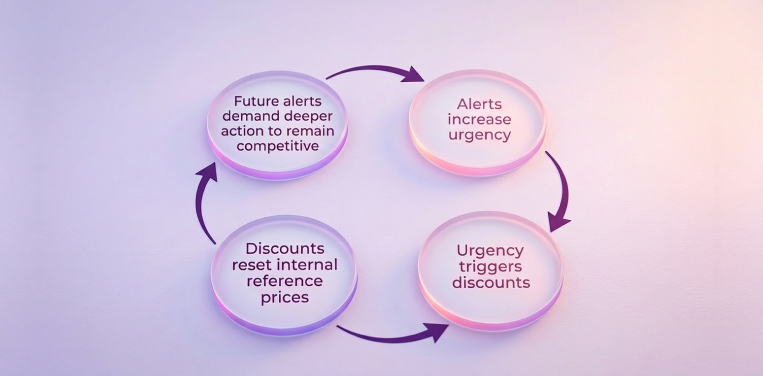
The team ends up working harder while outcomes get worse.
Stopping false alarms is not only a data improvement. It is margin protection.
How Competitor AI Reduces False Alarms at the Source
Competitor AI helps reduce alert noise by improving the quality of competitive inputs before they reach decision-making.
It supports accurate product matching so comparisons reflect true equivalents instead of lookalikes. That reduces false gaps caused by variants, pack-size differences, bundles, and configuration drift. It also supports relevance filtering so competitive signals are grounded in competitors and offers that truly matter for your market and customer.
Competitor monitoring can be configured on daily, weekly, or monthly refresh cycles depending on category volatility and business needs.
When the input signal improves, the alert volume drops for the right reason. The system stops crying wolf.
Set Meaningful Alert Thresholds That Reflect Business Impact
Even with good matching, not every gap deserves action.
One of the fastest ways to reduce noise is to define what a meaningful gap actually is. Many teams treat any difference as a threat. In practice, the threshold should reflect impact. A tiny price difference may not change demand. A larger difference on a highly visible item might.
This is where competitive tracking should shift from alerting on differences to alerting on risk. That risk can be defined using thresholds and rules that align to category volatility, product role, and margin constraints.
How Pricing AI Prevents Alerts From Turning Into Cascades
Reducing alerts is not enough. You also need a disciplined decision system for the alerts that remain.
Pricing AI supports this by grounding actions in expected demand response using historical sales and pricing patterns. Instead of treating competitive gaps as automatic triggers, Pricing AI helps teams decide:
- Will closing this gap likely change outcomes enough to justify the margin trade
- Is a hold the smarter move because demand is resilient
- Is a small adjustment sufficient rather than a deep cut
- Should this item be routed for review because the signal is uncertain
Pricing AI also supports guardrails that prevent reactive decisions from becoming broad cascades, such as:
- Margin floors to protect profitability
- Movement limits to prevent repeated discounting
- Meaningful gap thresholds so teams do not chase trivial differences
- Rules that isolate actions to the items that truly require competitiveness
This is how Pricing Software for Retail and Pricing Software for Ecommerce turns competitive tracking into controlled execution.
A Practical Operating Model to Stop the Noise
The most effective approach is operational, not theoretical.
Start by classifying alerts into three groups:
- Validated and meaningful gaps that require a decision
- Uncertain gaps that require review due to low confidence or unclear comparability
- Noise that should be suppressed because it is irrelevant or too small to matter
Then work the decision queue on a set cadence. Teams focus on the validated gaps and apply disciplined holds where appropriate. Review items are handled by exception, not by default. Noise stays out of the workflow.
This model reduces manual effort and prevents teams from being pulled into reactive pricing just because an alert exists.
From Alert Fatigue to Disciplined Competitiveness
Competitive tracking should improve pricing discipline. If it creates panic, it needs to be redesigned.
Competitor Analysis Software for Retail, Competitor Analysis Software for Ecommerce, Pricing Software for Retail, and Pricing Software for Ecommerce supported by Competitor AI and Pricing AI enables teams to:
- Reduce false alarms with accurate product matching and relevance filtering
- Focus alerts on meaningful gaps rather than tiny differences
- Prevent noisy signals from triggering broad price changes
- Use guardrails to protect margin and avoid discount cascades
- Hold price with confidence when competitive pressure is not decisive
This approach transforms competitive tracking from noise generation into disciplined decision support.

Conclusion
False alarms in competitive tracking are not a minor annoyance. They are one of the most common triggers of reactive discounting and margin leakage. They come from non-equivalent comparisons, distorted offers, irrelevant competitors, and thresholds that flag differences that do not matter.
Modern Competitor Analysis Software for Retail, Competitor Analysis Software for Ecommerce, Pricing Software for Retail, and Pricing Software for Ecommerce helps stop that pattern. Competitor AI improves matching accuracy and relevance filtering so competitive signals are trustworthy. Pricing AI supports disciplined decisions and guardrails so teams respond to real market pressure, not noisy alerts.
Hypersonix helps pricing teams move from alert fatigue to controlled competitiveness, which is where margin protection and speed can coexist.







Ready to Let AI Agents Work for Your Margins?
Leading brands are already growing profits on autopilot. Join them.


Trusted by 1000+ leading retail brands