Retail pricing teams are flooded with competitive signals. Every week brings new promotions, flash sales, bundles, and limited-time discounts. Online channels amplify this even more, because shoppers see lower prices instantly and internal stakeholders see competitor screenshots just as fast.
The problem is that a large share of competitor price movement is not structural. It is promotional noise. A weekend discount, a clearance push, a bundle offer, or a member-only deal can look like the market has moved, even when the everyday price position has not changed.
When teams treat promotional prices as true market shifts, the results are predictable. Base prices drift downward, margins erode, and the retailer ends up funding competitiveness on items that never needed a permanent reduction. Over time, the business becomes trapped in deeper discounting just to maintain the same performance.
This is where Competitor Analysis Software for Retail, Competitor Analysis Software for Ecommerce, Pricing Software for Retail, and Pricing Software for Ecommerce should do more than display competitor prices. Competitor AI helps distinguish comparable everyday pricing from temporary promotional mechanics through accurate matching and relevance filtering. Pricing AI helps teams decide when to respond, when to hold, and how to use guardrails so promotions do not reset the price floor.
Before outlining the solution, it helps to understand why promo noise is so easy to misread.

Why Promotions Look Like Market Shifts
Promotions are designed to create urgency. They are also designed to be visible. In ecommerce, a promo price often becomes the first price a shopper sees, which makes it feel like the new market price.
Inside the organization, promotions create immediate pressure. Stakeholders see competitor deals and assume the business is now uncompetitive. Pricing teams get asked to match quickly, often without time to validate whether the offer is truly equivalent or whether it will last beyond the weekend.
The issue is not that promotions exist. The issue is that many pricing processes do not separate promo prices from structural competitor pricing. Without that separation, every promo becomes a perceived emergency.
The Cost of Treating Promo Prices as Structural
When a retailer reacts to promotional noise, the damage can be larger than the original gap.
A temporary competitor promo triggers a price cut. That cut then becomes an internal baseline. Merchandising teams want consistency, so adjacent items may shift. Finance sees margin decline, so they ask for recovery later. The pricing team then faces the next competitor promo with less room to maneuver.
Over time, a pattern emerges: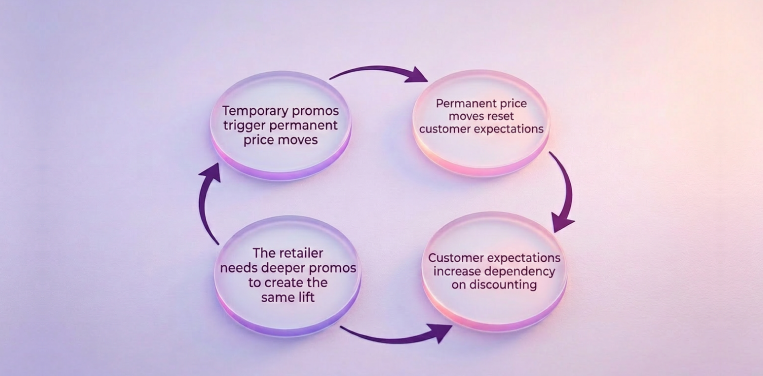
This is how promotional noise becomes a structural margin problem.
Why Competitive Tracking Often Amplifies Noise
Many competitive tracking systems are built to capture changes quickly, not to interpret them correctly. They flag any price change and treat it as comparable pressure.
In reality, competitor prices can reflect:
- Limited-time flash sales
- Member-only pricing
- Bundles and multi-buy offers
- Clearance for specific variants or pack sizes
- Channel-specific conditions
If competitive tracking does not identify these conditions and validate equivalence, it produces alerts that create urgency even when the market has not structurally moved.
This is why Competitor Analysis Software for Ecommerce is especially important. Ecommerce surfaces promos constantly, and noisy signals spread faster online than in-store.
How Competitor AI Separates Structural Signals From Promo Noise
Competitor AI reduces promo-driven misreads by improving competitive context.
First, it supports accurate product matching so comparisons are made between true equivalents, not lookalikes that differ by pack size, variant, or included components. This prevents false pressure driven by non-equivalent offers.
Second, it supports relevance filtering so pricing teams focus on competitor moves that matter for their market and category, instead of reacting to every visible deal.
Third, it helps teams interpret competitor pricing with better context, so they can distinguish a temporary promotional offer from a more durable price position change.
Competitor monitoring can be configured on daily, weekly, or monthly refresh cycles depending on category volatility and business needs.
When promo noise is filtered, teams stop treating every weekend deal like a new market baseline.
How Pricing AI Helps Teams Decide When to Hold Versus Respond
Once promotional noise is separated from real competitive signals, pricing teams still need a decision system. Even a true competitor price shift does not always require an immediate match.
Pricing AI supports disciplined decisioning by grounding recommendations in expected demand response using historical sales and pricing patterns. This helps teams answer questions such as:
- Will responding to this competitor move materially change demand
- Is a hold the better decision because demand is resilient
- Is a small adjustment enough rather than a broad reduction
- Does the recommendation stay within margin and movement guardrails
This is the core advantage of Pricing Software for Retail and Pricing Software for Ecommerce. It turns competitive tracking into controlled action rather than reflex discounting.
Guardrails That Prevent Promotions From Resetting Your Price Floor
Promotions are not the enemy. The price floor reset is.
Pricing discipline requires guardrails that keep temporary events from becoming permanent reductions. Practical guardrails include:
- Movement limits so prices do not drift down through repeated reactions
- Margin floors so competitiveness does not destroy profitability
- Meaningful gap thresholds so teams do not chase trivial differences
- Rules that separate promo response from everyday price posture
These guardrails help pricing teams compete tactically while protecting long-term pricing integrity.
A Practical Operating Model: Treat Promos as Events, Not Benchmarks
The simplest way to avoid promo-driven pricing drift is to operationalize the difference between events and benchmarks.
Events are short-term promotional prices. They can inform tactical actions, but they should not redefine everyday pricing.
Benchmarks are structural competitor positions based on comparable offers and stable pricing behavior.
A disciplined model looks like this:
- Use Competitor AI to validate equivalence and identify when a competitor move is likely promotional
- Route only meaningful, validated shifts into the decision queue
- Use Pricing AI to decide whether response will pay back based on expected demand impact
- Keep the rest stable within guardrails, and review outcomes on a consistent cadence
This approach reduces unnecessary price changes and protects margin through promo-heavy periods.
From Promo Panic to Disciplined Competitiveness
Retailers do not lose margin because competitors run promotions. They lose margin because they treat promotions as structural price shifts.
Competitor Analysis Software for Retail, Competitor Analysis Software for Ecommerce, Pricing Software for Retail, and Pricing Software for Ecommerce supported by Competitor AI and Pricing AI enables teams to:
- Separate promotional noise from meaningful competitive signals
- Improve comparability through accurate matching and relevance filtering
- Avoid permanent base price moves triggered by short-term competitor promos
- Use guardrails to prevent drift and protect pricing integrity
- Respond only when expected demand impact justifies the trade
This approach transforms competitive pressure into controlled competitiveness.

Conclusion
Competitive pressure is real, but much of what pricing teams see day to day is promotional noise. When short-term promos are treated as structural market shifts, base prices drift downward and margin leakage becomes permanent.
Modern Competitor Analysis Software for Retail, Competitor Analysis Software for Ecommerce, Pricing Software for Retail, and Pricing Software for Ecommerce helps teams avoid that trap. Competitor AI improves matching accuracy and relevance filtering so promo-driven signals do not distort perception of the market. Pricing AI supports disciplined decisions and guardrails so teams respond selectively and hold price with confidence when it is the smarter move.
Hypersonix helps retailers compete through promotion-heavy periods without letting temporary noise reset long-term profitability.






Ready to Let AI Agents Work for Your Margins?
Leading brands are already growing profits on autopilot. Join them.


Trusted by 1000+ leading retail brands