Private label is one of the strongest levers retailers have for margin, loyalty, and differentiation. It gives you control over assortment, positioning, and value perception in a way national brands rarely allow. But private label also creates a pricing challenge that teams feel every day: there is often no perfect competitor match.
When a national brand drops price, the comparison is obvious. When a competitor runs a promotion on a similar item, the comparison may still be straightforward. But with private label, there is rarely a clean 1:1 equivalent. That leads many teams back to manual work, arguing over what is “close enough,” relying on spreadsheets, or defaulting to simple markups that ignore market context.
Modern Pricing Software for Retail and Pricing Software for Ecommerce solves this by changing the question. Instead of asking, “What is the competitor’s price for the exact same item?” it asks, “What are the right branded anchors and competitive references that shape the shopper’s perception of this product?” Competitor AI helps identify and benchmark against those relevant anchors using accurate product matching and relevance filtering. Pricing AI then sets defendable price ranges and guardrails based on expected demand response and business constraints, even when direct matches do not exist.
Before outlining how this works, it helps to understand why private label pricing fails when teams treat it like branded pricing.
Why Private Label Pricing Breaks Traditional Competitive Rules
Most competitive pricing rules assume there is a direct peer. Match the lowest. Stay within a percent of competitor X. Track price index against the same UPCs.
Private label breaks those assumptions. Two items can serve the same shopper need while differing in size, formulation, quality tier, feature set, sourcing, or packaging. Even within the same category, one retailer’s private label “premium” is not comparable to another retailer’s entry tier.
When retailers force private label into direct-match logic, they either price too low and give away margin, or they price too high and lose volume because the value story is not supported by the market.
This is exactly where Pricing Software for Retail and Pricing Software for Ecommerce must operate differently. The goal is to price private label with market awareness and internal consistency, not with fragile 1:1 comparisons.

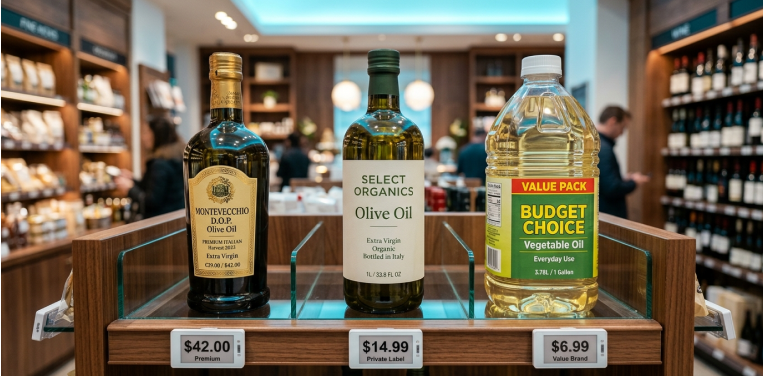
Branded Anchors Are How Shoppers Judge Private Label Value
Even when a shopper buys private label, their perception is often anchored by branded alternatives. They compare features, quality cues, and price points across a set of familiar references.
A private label product typically lives in one of three anchor relationships:
-
Value alternative: priced below a mainstream brand as a smart trade-down
-
Parity alternative: priced close to a mainstream brand with a clear value justification
-
Premium alternative: priced near or above a mainstream brand because the offering is differentiated
The key is that these anchors vary by category and by tier. A private label premium item should not be anchored to the cheapest branded product. A value-tier private label item should not be anchored to a premium brand.
Competitor AI helps retailers identify the right branded and competitive anchors that shape price perception, rather than forcing a false direct match.
How Competitor AI Benchmarks Without 1:1 Matches
Competitor AI is most powerful in private label pricing when it is used to build a credible benchmark set, not a single comparison.
It does that by supporting accurate product matching across attributes and by surfacing comparable branded items that share meaningful characteristics, such as size, key attributes, specifications, and positioning signals. Instead of chasing an identical item that does not exist, the system helps pricing teams benchmark private label against a structured reference set.
This benchmarking becomes stronger when relevance filtering is applied. Not every competitor offer is a meaningful reference. Some are bundles. Some are short-term promotions. Some are variants that are not equivalent. Competitor AI helps keep the benchmark clean so the anchor set reflects true market context.
Competitor monitoring can be configured on daily, weekly, or monthly refresh cycles depending on category volatility and business needs.
The Goal Is a Defendable Range, Not a Single “Correct” Price
One of the biggest private label mistakes is treating the price as a point. Private label pricing works better when it is treated as a range.
A defendable range reflects the reality that private label competes on a value promise, not exact equivalence. It allows teams to price confidently as long as they stay within the boundaries that preserve the intended position.
For example, if the private label item is a value alternative, the range might be defined relative to a set of branded anchors, with guardrails that maintain a clear savings story. If it is parity, the range might allow the private label item to sit close to the brand, supported by better margins and strong conversion. If it is premium, the range might preserve price integrity and prevent unnecessary discounting during competitor promotions.
Pricing Software for Retail and Pricing Software for Ecommerce supports this range-based logic so teams do not have to justify every price as if it had a direct twin in the market.
How Pricing AI Sets Guardrails and Price Discipline
Once the anchor set is credible, Pricing AI helps translate that context into pricing decisions that are consistent and scalable.
Pricing AI analyzes historical pricing and sales response to estimate how demand changes when prices shift. For private label, this helps teams avoid two traps: overreacting to branded promotions and assuming demand will behave like a national brand.
Pricing AI supports guardrails such as:
- Minimum savings thresholds versus branded anchors for value-tier private label
- Maximum premium thresholds for premium-tier items to preserve credibility
- Margin floors so private label does not sacrifice its profit role
- Movement limits so prices do not swing unnecessarily during competitor promotions
- Tier gap protection so good-better-best price architecture stays intact
These guardrails are how pricing teams maintain consistency across thousands of SKUs while still responding to real market pressure when needed.
Ecommerce Makes Private Label Benchmarking Even More Important
In ecommerce, shoppers filter, sort, and compare with speed. The value story of private label is often decided in a search results page where the shopper sees price, ratings, size, and a few cues.
If the private label item is priced outside a credible range, the shopper may never click. If it is priced too low, the retailer gives away margin without improving perception beyond a certain point.
That is why Pricing Software for Ecommerce needs to keep private label within defendable ranges that align with branded anchors, while ensuring competitive references are accurate and not distorted by mismatched variants or promotional noise.
Operationalizing Private Label Pricing Without Spreadsheets
Private label pricing becomes manageable when teams stop trying to solve it SKU by SKU manually and instead implement a repeatable operating model:
- Define private label tiers and intended position (value, parity, premium)
- Build branded anchor sets using Competitor AI benchmarking and relevance filtering
- Set defendable ranges and guardrails in Pricing AI that reflect tier strategy and margin goals
- Review exceptions on a cadence, focusing only on items that move out of range or show meaningful performance shifts
- Refine anchor sets and thresholds as categories evolve
This keeps pricing consistent and reduces manual debate, while still allowing the business to compete intelligently.

From Direct Matching to Market-Aware Private Label Pricing
Private label wins when the customer understands the value, the assortment feels intentional, and the pricing stays consistent with the promise.
Pricing Software for Retail and Pricing Software for Ecommerce powered by Pricing AI and Competitor AI enables retailers to:
- Benchmark private label against the right branded anchors when no direct match exists
- Filter competitor comparisons so promotions, variants, and non-equivalent offers do not distort pricing decisions
- Set defendable price ranges that preserve the value story and protect margin
- Apply guardrails that keep private label disciplined across tiers and assortments
- Focus teams on exceptions instead of spreadsheet-driven SKU-by-SKU debates
This approach transforms private label pricing from manual judgment calls into a scalable system.
Conclusion
Private label pricing is challenging because direct matches rarely exist, but that does not mean pricing has to be guesswork. The right approach is to benchmark against relevant branded anchors and price within defendable ranges supported by guardrails.
Modern Pricing Software for Retail and Pricing Software for Ecommerce makes that possible. Competitor AI builds credible benchmark sets through accurate matching and relevance filtering. Pricing AI translates those benchmarks into disciplined ranges and recommendations grounded in demand response and business constraints.
Platforms like Hypersonix help retailers price private label with confidence, protect margin, and maintain a consistent value promise, even when the market does not offer clean 1:1 comparisons.






Ready to Let AI Agents Work for Your Margins?
Leading brands are already growing profits on autopilot. Join them.


Trusted by 1000+ leading retail brands