Grocery retail operates at a different speed than almost any other category. Thousands of high velocity SKUs move daily. Price perception is constant. Competitor activity is relentless. Customers are highly aware of price, especially on everyday staples.
In this environment, retailers often default to aggressive discounting to protect traffic and basket size. When competitors drop prices on key items, reaction feels necessary. When sales fluctuate, promotions expand. Over time, this creates a pattern of over-discounting that quietly erodes margin.
The problem is not responsiveness. It is precision.
Modern Pricing Software for Retail must help grocery retailers manage high velocity assortments without falling into the trap of unnecessary price matching. That requires understanding elasticity differences between staples and discretionary items and filtering competitive noise before it drives margin leakage.
With Pricing AI and Competitor AI working together, platforms like Hypersonix enable grocery retailers to act quickly while maintaining pricing discipline.
Before exploring how this works, it is important to understand why grocery pricing is uniquely complex.
Why Grocery Pricing Is Different
Grocery retail is shaped by three structural realities.
First, volume is high and frequent. Many SKUs sell daily in large quantities, especially staples such as milk, bread, eggs, rice, and packaged essentials.
Second, price perception is sensitive. Customers often use a small group of known value items to judge overall store affordability.
Third, competitive noise is constant. Local competitors, regional chains, discount retailers, and digital marketplaces all adjust prices frequently, sometimes multiple times per week.
Traditional pricing systems struggle in this environment because they treat all SKUs and competitor moves equally. In grocery, that assumption is costly.
Staples vs Discretionary: Elasticity Is Not Uniform
One of the most important distinctions in grocery retail is between staple and discretionary items.
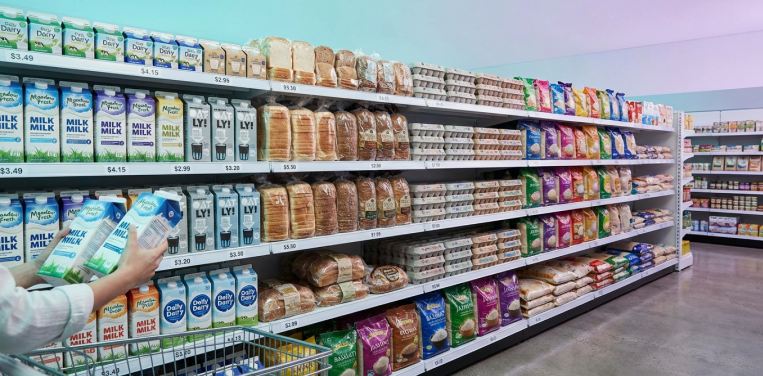
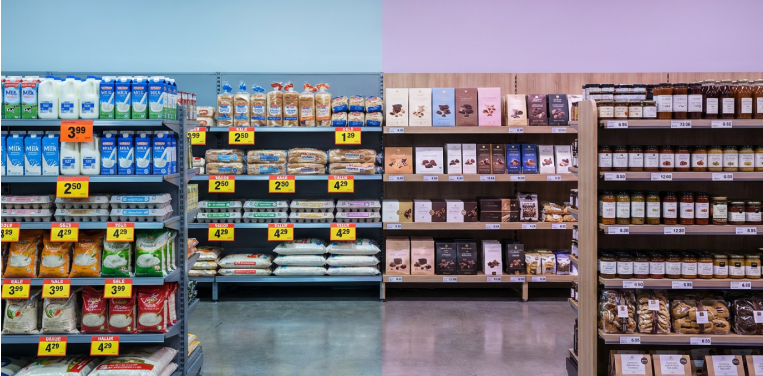
Staples are frequently purchased, highly visible, and often used for price comparison. These products tend to show higher elasticity. Small price changes can meaningfully influence demand and customer perception.
Discretionary products behave differently. Specialty snacks, premium brands, seasonal items, and niche categories often show lower elasticity. Customers may value convenience, brand preference, or impulse appeal more than minor price differences.
When Pricing Software for Retail fails to distinguish between these two elasticity patterns, it leads to broad discounting across the assortment.
Discounting discretionary items that are not price sensitive simply transfers margin to customers without increasing volume. At the same time, overreacting on staples can trigger price wars that permanently reset baseline pricing lower.
SKU level elasticity modeling is essential to manage this complexity.
How Pricing AI Protects Margin in High Velocity Categories
Pricing AI models elasticity at the SKU and product cluster level using real sales response and historical pricing behavior. Instead of assuming that all grocery items are highly price sensitive, it evaluates how demand actually reacts to price changes.
For staple SKUs, Pricing AI can identify where competitive alignment is necessary to protect traffic and basket size.
For discretionary SKUs, it often reveals that demand remains stable even when competitors discount. In these cases, holding price protects margin without sacrificing volume.
This differentiation is critical in high velocity environments where small pricing errors compound quickly. Across thousands of SKUs, even minor unnecessary discounts can create significant margin leakage over time.
Modern Pricing Software for Retail must enable this level of precision to remain profitable in grocery.
Managing Competitor Noise Without Overreaction
Grocery retailers operate in markets where competitor price changes are frequent and often temporary. A local chain may run a short term promotion on a key item. A discount retailer may experiment with aggressive pricing on selected SKUs. Digital marketplaces may surface limited time offers.
Without intelligent filtering, every competitor move appears urgent.
Competitor AI changes this dynamic by interpreting relevance rather than simply tracking activity.
It ensures accurate product matching so that comparisons are made only against true equivalents. It distinguishes between temporary promotions and sustained price shifts. It evaluates which competitors historically influence demand and which do not.
This allows Pricing Software for Retail to prioritize meaningful threats while ignoring noise.
Instead of reacting to every price fluctuation, grocery retailers can focus on competitive moves that genuinely impact customer behavior.
Preventing Over-Discounting on High Velocity SKUs
Over-discounting in grocery often begins with good intentions. Protect traffic. Stay competitive. Maintain price image.
But when discounts are applied too broadly or too frequently, they reshape customer expectations. Baseline margins shrink. Promotional effectiveness declines. Profitability becomes harder to recover.
Elasticity signals provide the evidence needed to prevent this cycle.
If demand for a high velocity SKU remains stable despite competitor movement, Pricing AI can recommend holding price. If elasticity indicates genuine sensitivity, it can guide proportionate adjustments rather than blanket reductions.
This disciplined approach ensures that discounting is applied where it drives incremental demand and avoided where it does not.
Pricing Software for Retail must support both responsiveness and restraint.
Micro Adjustments That Scale Across the Assortment
In grocery, small decisions scale quickly.
A one percent unnecessary discount on a high velocity staple can significantly impact margin. Conversely, a small price increase on a low elasticity discretionary SKU can generate meaningful profit without affecting volume.
Pricing AI identifies these micro opportunities continuously. When applied across thousands of SKUs, they create compounding margin improvement.
This is especially important in grocery, where margins are traditionally thin and operational complexity is high.
Continuous intelligence allows pricing teams to manage velocity without losing control.
Explainable Intelligence Builds Operational Confidence
Grocery pricing decisions affect multiple stakeholders including merchandising, finance, and store operations. Rapid price movement without transparency can create internal friction.
Explainable Pricing AI provides clarity behind every recommendation. Teams can see how elasticity influenced the decision, which competitors were evaluated, and what impact is expected on demand and margin.
This visibility builds confidence in price holds and targeted adjustments. Instead of reacting emotionally to competitor movement, teams align around data driven reasoning.
Pricing Software for Retail must not only generate insight. It must make that insight actionable and defensible.
Conclusion: From Reaction to Discipline in Grocery Retail
High velocity environments demand speed. But speed without intelligence leads to unnecessary discounting.
Modern Pricing Software for Retail must help grocery retailers manage staples and discretionary products differently, interpret competitor noise accurately, and apply elasticity driven decisions at scale.
By combining Pricing AI and Competitor AI, Hypersonix enables grocery retailers to protect margin while remaining competitive on the products that truly define price perception.
In a category where every basis point matters, the retailers who succeed will not be those who discount the most. They will be those who understand where price truly drives demand and act with precision.