Premium pricing is often tested by competitive pressure. A competitor runs a limited-time promotion. A marketplace seller lists a lower price. A similar product appears discounted. A seasonal event creates pressure to react. For pricing, merchandising, ecommerce, and finance teams, the visible signal can feel simple: someone is cheaper, so should we respond?
For premium brands, the answer is often more nuanced.
A lower price is not always a reason to cut. The competitor offer may be temporary, non-equivalent, tied to different seller terms, supported by weaker service, or unlikely to change customer demand. The product may carry brand equity, differentiated quality, stronger availability, better warranty support, or a more trusted customer experience. In these cases, holding price can protect more value than reacting.
But price holds are often misunderstood.
A price move is visible. It feels like action. A price hold can look like inaction unless the reasoning is clearly documented and measurable. That is where explainable price holds become critical.
An explainable price hold turns restraint into a deliberate business decision. It shows why a price should not move, what evidence supports the hold, which risks were evaluated, and how the decision protects margin, price architecture, and brand value.
Hypersonix helps premium brands make price holds more disciplined and defensible by connecting cleaner competitor intelligence, product matching, relevance filtering, expected demand impact, inventory and forecasting context, business guardrails, and exception-driven workflows. Competitor AI helps validate whether competitive offers are truly comparable. Pricing AI uses historical sales and pricing patterns to support targeted recommendations, disciplined holds, and expected demand impact. Guardrails such as margin floors, movement limits, meaningful gap thresholds, and price holds help teams avoid unnecessary reductions when the business case for a price move is weak.
The goal is not to avoid every price move. It is to make sure that holding price is treated as a measurable decision when restraint protects more value than a reaction.

Why Price Holds Matter More in Premium Categories
Premium brands operate with a different pricing responsibility.
Customers are not only buying the product. They are buying quality, trust, design, performance, exclusivity, service, craftsmanship, status, brand promise, or a differentiated experience. Price plays a role, but it is rarely the only factor.
This matters because unnecessary reductions can do more than reduce margin on a single transaction. They can affect how customers understand the brand.
A repeated price cut can teach shoppers to wait. It can narrow the perceived distance between premium and mass alternatives. It can weaken price architecture across good, better, best tiers. It can create internal pressure to match future promotions even when the original signal was weak. It can make full-price selling harder over time.
In premium categories, a price hold can protect:
- brand value
- margin integrity
- price architecture
- premium positioning
- customer reference price
- full-price conversion potential
- promotional discipline
- channel consistency
A price hold is not passive. When supported by evidence, it is a margin and value protection decision.
The Problem With Treating Holds as “No Action”
Many pricing workflows are built around movement.
A competitor is cheaper, so the system flags an exception. A recommendation appears. A pricing team reviews the change. The decision is recorded if the price moves.
But when the decision is to hold, the logic is often less visible.
That creates several problems. Teams may not know whether the hold was intentional or simply ignored. Merchandising may revisit the same issue repeatedly. Finance may question why no action was taken. Ecommerce teams may feel pressure because the visible competitor price remains lower. Leadership may see fewer price moves but not understand the value protected by restraint.
An explainable hold solves this by documenting the reason for not moving.
The hold becomes part of the pricing workflow, with a clear rationale, supporting evidence, and a measurable outcome. The team can see that the product was reviewed, the competitor signal was evaluated, the expected demand impact was considered, and the decision was made within approved guardrails.
That turns “nothing changed” into “we chose not to change because the evidence did not justify a move.”
Competitive Signals Need Validation Before They Create Pressure
Premium brands often face misleading competitor signals.
A marketplace seller may list a lower price, but the seller may not be a relevant benchmark. A competitor may discount an older model, different size, different material, or lower-service offer. A retailer may run a temporary promotion that should not reset the base price. A third-party listing may have weaker warranty terms, unclear fulfillment, limited availability, or different product condition.
If teams react before validating these signals, premium brands can give away margin without improving competitive position.
Hypersonix Competitor AI helps improve product matching and relevance filtering so teams can distinguish true-equivalent comparisons from misleading ones. This is especially important in premium categories where small differences in product, offer, or seller context can justify a meaningful price difference.
Before a premium product is moved because of a competitor gap, teams should understand:
- Is the product truly equivalent?
- Is the competitor seller relevant?
- Are warranty, service, delivery, or return terms comparable?
- Is the competitor offer temporary or persistent?
- Is the price gap meaningful enough to affect demand?
- Does the product’s role support a price response?
- Would the move weaken margin or price architecture?
When these questions do not support a reduction, a price hold should be visible, documented, and explainable.
Product Equivalence Is Not Always Obvious
Premium products can be difficult to compare.
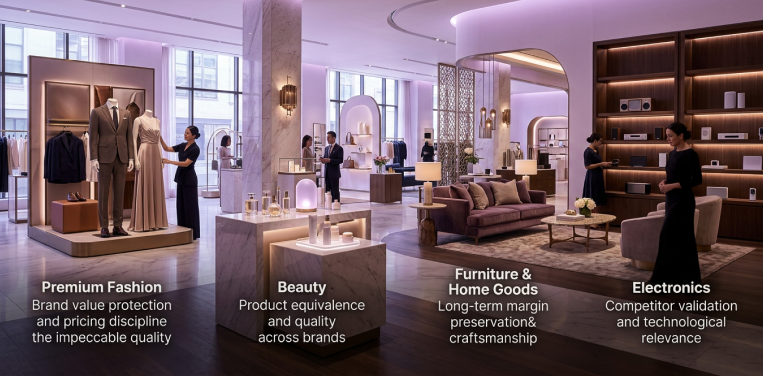
Two items may look similar online but differ in material, formulation, model year, craftsmanship, configuration, size, quality tier, bundle, warranty, service level, or brand positioning. In categories like beauty, furniture, electronics, apparel, sporting goods, home goods, and specialty retail, these differences can materially change customer value.
A competitor’s lower price may be based on a product that is not truly equivalent.
For example, a premium skincare product may be compared against a different size or formulation. A furniture item may look similar but use different materials or exclude delivery and assembly. A high-end jacket may be compared with a lower-quality fabric or last-season style. A premium electronics product may be compared against a different configuration or older model. A specialty product may be compared against a seller that does not offer the same warranty or service.
If the comparison is not equivalent, a price cut is not a competitive move. It is unnecessary margin loss.
An explainable price hold can show the mismatch clearly. It gives teams confidence to maintain price when the lower offer is not a true benchmark.
Expected Demand Impact Helps Defend Restraint
Even when the competitive comparison is valid, a price move may not be worth it.
Premium customers may be less responsive to small price differences when the product offers stronger quality, trust, availability, service, or brand value. A price reduction may increase units slightly but still fail to recover the margin given up. In some cases, the move may create more long-term harm than short-term benefit.
This is why expected demand impact matters.
Hypersonix Pricing AI uses historical sales and pricing patterns to support expected demand impact at the SKU or product-cluster level. This helps teams evaluate whether a proposed reduction is likely to generate enough incremental demand to justify the margin trade-off.
A price hold may be the better decision when:
- expected demand impact is limited
- demand has remained stable despite competitor gaps
- inventory pressure is manageable
- the product is differentiated or premium-positioned
- the competitor offer is weak or temporary
- the price move would breach margin guardrails
- recent price movement already occurred
- the reduction could weaken price expectations
With explainability, teams can defend the hold with evidence rather than preference.

Price Holds Protect Price Architecture
Premium brands often manage deliberate price relationships.
A good, better, best structure may exist across product tiers. A private label premium product may need to sit at a specific distance from national brands. A hero product may anchor category value. A limited-edition item may need to maintain scarcity and perceived worth. A high-service offer may justify a premium over lower-service competitors.
Unnecessary price cuts can disrupt these relationships.
If one product moves too far down, it can compress the gap to lower tiers. If a premium item is discounted too often, it may become harder to justify its position. If a hero product is reduced repeatedly, the category’s reference price can shift.
Price holds help protect architecture when a move would create more damage than value.
Hypersonix supports business guardrails such as margin floors, movement limits, meaningful gap thresholds, price holds, category-specific rules, and exception-based review. These guardrails help teams evaluate whether a recommendation fits the broader pricing strategy before action is taken.
A hold can be the right decision when protecting the architecture matters more than matching a temporary or questionable competitor signal.
Movement Limits Prevent Premium Price Drift
Premium brands need to track how often prices move.
A single price cut may be manageable. Repeated small reductions can create price drift. Over time, the product’s base price may move away from its intended position, even if no single decision looked dramatic.
Movement limits help reduce this risk.
They can flag products that have changed too often, restrict repeated reductions within a period, or require review when another move would pull the price outside an acceptable range. This is especially useful for premium products, where frequent movement can weaken customer expectations and reduce trust in the everyday price.
Hypersonix supports movement controls as part of a broader guardrail framework. When a product has already moved recently, a new recommendation can be routed for review or held if expected demand impact is weak.
This makes pricing discipline more consistent. It also prevents reactive decision-making from becoming a pattern.
Meaningful Gap Thresholds Reduce Noise
Not every competitor gap matters.
A small price difference may not influence demand when the retailer offers stronger service, better availability, superior brand trust, exclusive assortment, or better support. A larger gap may still not matter if the competitor product is not equivalent or the offer is temporary.
Meaningful gap thresholds help teams avoid reacting to differences that are too small or too weak to justify action.
For premium brands, thresholds may need to reflect:
- product differentiation
- customer price sensitivity
- competitor relevance
- seller credibility
- service and warranty terms
- availability
- brand positioning
- margin exposure
- historical demand response
Hypersonix supports meaningful gap thresholds so teams can filter competitor signals before they turn into price pressure.
When a gap does not meet the threshold, an explainable hold can show why restraint is justified.
Inventory and Forecasting Context Can Support a Hold
Inventory matters in premium pricing.
If inventory is healthy and demand is stable, there may be little reason to cut price. If inventory is constrained, a price reduction may not create additional value and may simply give away margin. If inventory is building and forecasted demand is soft, a targeted promotion or price review may be worth considering.
The decision depends on context.
Hypersonix helps connect pricing, inventory, and forecasting signals so teams can understand whether pressure is competitive, operational, seasonal, or lifecycle-related.
A price hold may be appropriate when:
- inventory is within plan
- demand outlook remains healthy
- the product is not approaching lifecycle risk
- supply is constrained
- the issue is not price-driven
- a promotion or merchandising action may be more appropriate than a base price cut
By documenting this context, teams can show why holding price protects value.
Explainable Holds Improve Cross-Functional Alignment
Premium pricing decisions often involve multiple teams.
Pricing may focus on margin and demand response. Merchandising may focus on assortment and competitive positioning. Ecommerce may focus on conversion. Finance may focus on profitability. Brand teams may focus on value perception. Operations may focus on availability and service levels.
When a competitor appears cheaper, each team may interpret the risk differently.
Explainable price holds create a shared decision record. They clarify why a price was not moved and what evidence supports the decision.
An effective hold explanation may include:
- competitor match quality
- seller relevance
- product or offer differences
- expected demand impact
- margin risk
- inventory and forecast context
- recent price movement
- guardrail status
- recommended next review point
This reduces repeated debate and helps teams align around the same facts.
Holds Should Be Measured Like Price Moves
A price hold should have performance visibility.
If a team holds price, it should be able to evaluate whether the decision protected value. Did demand remain stable? Did margin hold? Did the competitor promotion end? Did the product continue to perform? Did inventory stay within plan? Did the hold avoid an unnecessary reduction?
Measuring holds helps teams learn where restraint works.
Useful questions include:
- Which holds protected margin without materially reducing demand?
- Which holds were later overridden, and why?
- Which competitor gaps disappeared after temporary promotions ended?
- Which products held price successfully despite visible undercuts?
- Where did holds fail because demand or inventory risk worsened?
- Which categories need different meaningful gap thresholds?
- Which product roles support stronger hold discipline?
Hypersonix supports explainable workflows and guardrails that help teams review outcomes and refine pricing rules over time.
The value of a hold should not be invisible. It should be part of the pricing performance story.
When a Price Hold Is the Right Decision
A price hold is not always correct. But it is often the best decision when the business case for a move is weak.
A hold may be appropriate when:
- the competitor product is not truly equivalent
- the seller is not a relevant benchmark
- the offer is temporary, limited, or conditional
- the gap is below a meaningful threshold
- expected demand impact is limited
- inventory pressure is manageable
- the product plays a premium or margin-protection role
- the move would breach margin floors or movement limits
- the product has already moved recently
- a base price cut would weaken price architecture
In these cases, reducing price may create more harm than value.
The important part is to make the hold explainable so it can be trusted, reviewed, and measured.
When a Hold Should Become a Review
Some cases are not clear enough for an immediate hold or move.
A review may be needed when the competitor offer appears meaningful but important details are uncertain. This can happen when product matching is ambiguous, seller terms are unclear, inventory risk is rising, or expected demand impact is mixed.
A review may be appropriate when:
- the product looks similar but attributes need validation
- the competitor offer includes unclear service or warranty terms
- inventory is building faster than expected
- the competitor gap persists across review cycles
- margin exposure is high
- the recommendation approaches a guardrail
- previous holds did not protect demand
Hypersonix exception-driven workflows can route these cases for review rather than forcing a premature move or hold.
This helps teams apply judgment where it matters most.
Price Execution Monitoring Protects the Decision
A price hold also needs operational follow-through.
If the approved decision is to hold price, teams need to ensure that no unintended price change occurs downstream. A price may be overwritten by another system, a promotion may remain active too long, a channel may show a different value, or a price may be changed outside the approved workflow.
Hypersonix price execution monitoring helps verify that approved pricing actions were implemented as intended. This includes helping teams identify missed, delayed, inconsistent, or incorrect price execution after approval.
For premium brands, execution accuracy matters because unintended price movement can weaken value perception and create margin leakage.
A hold only protects value if the market reflects the hold.
How Hypersonix Helps Premium Brands Make Holds Explainable
Hypersonix helps premium brands treat price holds as measurable pricing decisions.
Competitor AI improves product matching and relevance filtering so teams can validate whether a lower competitor price is truly comparable. Pricing AI uses historical sales and pricing patterns to support expected demand impact and targeted recommendations. Inventory and forecasting context helps teams understand whether pressure is tied to demand softness, stock exposure, lifecycle stage, or operational factors.
Business guardrails help teams apply margin floors, movement limits, meaningful gap thresholds, price holds, product-role rules, category-specific logic, and exception-based review. Explainable workflows help pricing, merchandising, ecommerce, finance, and brand teams understand why the right decision may be to move, hold, review, or investigate. Price execution monitoring helps verify that approved decisions are reflected correctly in the market.
Together, these capabilities help premium brands:
- identify when a lower competitor price is not a true undercut
- protect margin when expected demand impact is limited
- make holds visible and defensible
- preserve premium price architecture
- avoid repeated small reductions that create price drift
- apply guardrails that reflect product role and brand value
- route ambiguous cases for review
- measure the outcome of price holds over time
- verify that approved hold decisions are not disrupted by execution errors
The result is a pricing process where restraint is not hidden. It is documented, governed, and measured.
Conclusion
Premium brands do not protect value by reacting to every competitor price gap.
They protect value by knowing when a price move is justified and when restraint is the stronger decision.
An explainable price hold gives teams the evidence to defend that restraint. It shows that the competitor signal was reviewed, the product match was validated, the expected demand impact was considered, the guardrails were checked, and the decision to hold was intentional.
Hypersonix helps premium brands make this discipline practical with cleaner competitor intelligence, expected demand impact, inventory and forecasting context, business guardrails, explainable workflows, and price execution monitoring.
The strongest premium pricing teams do not ask only, “Should we match the lower price?”
They ask, “Will lowering price create enough value to justify the margin loss, or does holding protect the brand, the architecture, and the business better?”
That is how restraint becomes a measurable pricing decision, not a lack of action.






Ready to Let AI Agents Work for Your Margins?
Leading brands are already growing profits on autopilot. Join them.


Trusted by 1000+ leading retail brands