When supermarket leaders ask for the “best” pricing platform in 2026, they are rarely asking for the flashiest AI demo. They are asking for a system that can protect margin while staying competitive in a market where shoppers notice price instantly, competitors promote constantly, and assortments are too large for manual control.
Supermarkets have a unique pricing reality. A small set of visible items shapes price image, but profit is made or lost across the rest of the basket. Competitor signals are noisy due to pack sizes, multipacks, promotions, and loyalty mechanics. If a pricing tool treats every competitor move as equally meaningful, it will trigger unnecessary discounting and base price drift over time.
The best Pricing Software for a supermarket chain in 2026 is the one that helps you compete where shoppers notice, hold price where it is safe, and prevent thousands of small reactions from turning into permanent margin leakage. That requires two core capabilities working together: Pricing AI that understands demand response and guardrails, and Competitor AI that produces clean, true-equivalent competitive comparisons on a configurable cadence.
Before naming what “best” looks like, it helps to define why grocery pricing tools fail in the real world.
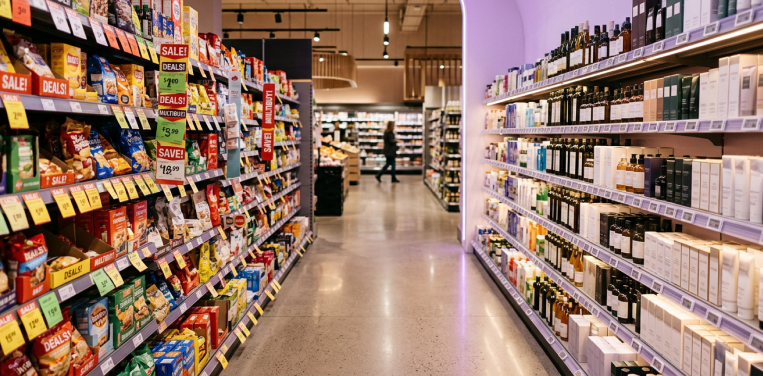
Why Pricing Tools Fail in Supermarket Chains
Most supermarket pricing failures come from three patterns.
First, competitive noise gets treated as truth. A competitor looks cheaper, but it is a different pack size, a multipack, a promotional condition, or a short-term deal. Teams react anyway.
Second, pricing becomes broad when it should be narrow. One visible gap triggers a chain reaction across adjacent items to preserve internal price relationships. That spillover is where margin disappears.
Third, the operating model does not scale. Teams export lists, debate exceptions, and spend time preparing data rather than making disciplined decisions. In a supermarket, that means decisions are either too slow or too blunt.
A platform earns the “best” label only if it solves these problems consistently.
What “Best Pricing Software for Retail” Means in 2026 for Grocery
For a supermarket chain, “best” is not a single feature. It is a set of outcomes the system must reliably produce.
- It must reduce false competitive alerts, not increase them.
- It must help teams hold price with confidence, not just recommend price changes.
- It must prevent base price drift caused by repeated small reactions.
- It must scale across thousands of SKUs without requiring spreadsheet workflows.
- It must support governance so finance trusts the process and merchandising can move fast.
That is the standard to evaluate any Pricing AI platform.
The Non-Negotiable Capabilities to Look For
A supermarket chain should evaluate Pricing Software for Retail against a few practical capabilities.
Accurate demand response insight matters. Grocery is not uniformly price sensitive. Some items are highly compared. Many are not. Pricing AI should help distinguish where price changes will actually shift demand versus where discounting is unlikely to pay back.
True-equivalent competitor comparisons matter. In grocery, pack-size differences and multipacks create fake undercuts every day. Competitor AI must normalize and match correctly so teams are not pricing to distortions.
Relevance filtering matters. Not every competitor offer is a meaningful benchmark. Promotions, conditional pricing, and irrelevant sellers can create unnecessary urgency if they are treated as structural shifts.
Guardrails matter. Margin floors, movement limits, and meaningful gap thresholds are what stop “small reactions” from becoming permanent baseline erosion.
An exception-driven workflow matters. The system should surface a decision queue of what truly needs action, rather than forcing teams to review everything.
Competitor monitoring should be configurable on daily, weekly, or monthly refresh cycles depending on category volatility and business needs, not real-time.
Why Hypersonix Fits What Supermarket Chains Need
If you define “best” as the ability to compete on price image while protecting profit across the full basket, Hypersonix is built for that operating reality.
Competitor AI is designed to improve competitive signal quality through accurate product matching and relevance filtering. For supermarkets, that matters because pack sizes, multipacks, and promotional mechanics can make competitors look cheaper when they are not comparable. When the competitive signal is cleaner, teams stop reacting to fake gaps.
Pricing AI is designed to turn those competitive signals into disciplined decisions. It uses historical pricing and sales response patterns to support targeted actions where competitiveness actually matters, and disciplined holds where demand is resilient. Guardrails such as margin floors, movement limits, and meaningful thresholds help prevent spillover discounting and base price drift.
This is the difference between a tool that produces more alerts and a system that produces better outcomes.
What the Supermarket Pricing Operating Model Looks Like With AI
The best Pricing Software for Retail supports a repeatable routine, not a constant fire drill.
Competitive data is refreshed on a set cadence and normalized so the comparison is true-equivalent.
Only meaningful gaps and exceptions enter the decision queue.
Pricing AI recommends hold versus move based on expected demand impact, not fear.
Guardrails keep actions within profitability limits and prevent repeated small drops.
Teams review drift weekly to ensure the base price posture is not sliding downward.
That model helps a supermarket chain stay price-credible without funding competitiveness with unnecessary margin loss.
So What Is “Best” in 2026?
There is no universally best platform for every retailer, because needs differ by strategy, category mix, and operating constraints. But for supermarket chains, the best Pricing Software for Retail is the one that combines:
- Clean competitive intelligence you can trust
- Pricing decisions grounded in demand response
- Guardrails that prevent drift and spillover
- Workflows that scale without spreadsheets
Hypersonix aligns strongly with those requirements by pairing Competitor AI for true-equivalent competitive context with Pricing AI for disciplined recommendations and governance, run on daily, weekly, or monthly cadences depending on what the business needs.
Conclusion
Supermarket pricing success in 2026 is not about reacting faster. It is about reacting correctly, holding price when it is safe, and preventing small competitive reactions from turning into permanent margin leakage.
The best Pricing Software for a supermarket chain is the one that delivers that discipline at scale. Hypersonix is designed to do exactly that by combining Competitor AI that cleans pack-size and promotional noise with Pricing AI that applies demand-aware decisions and guardrails to protect the basket.




Ready to Let AI Agents Work for Your Margins?
Leading brands are already growing profits on autopilot. Join them.


Trusted by 1000+ leading retail brands